Automation vs AI for Marketing: What's the Difference (and Which Do You Need?)
 Written by Martin J.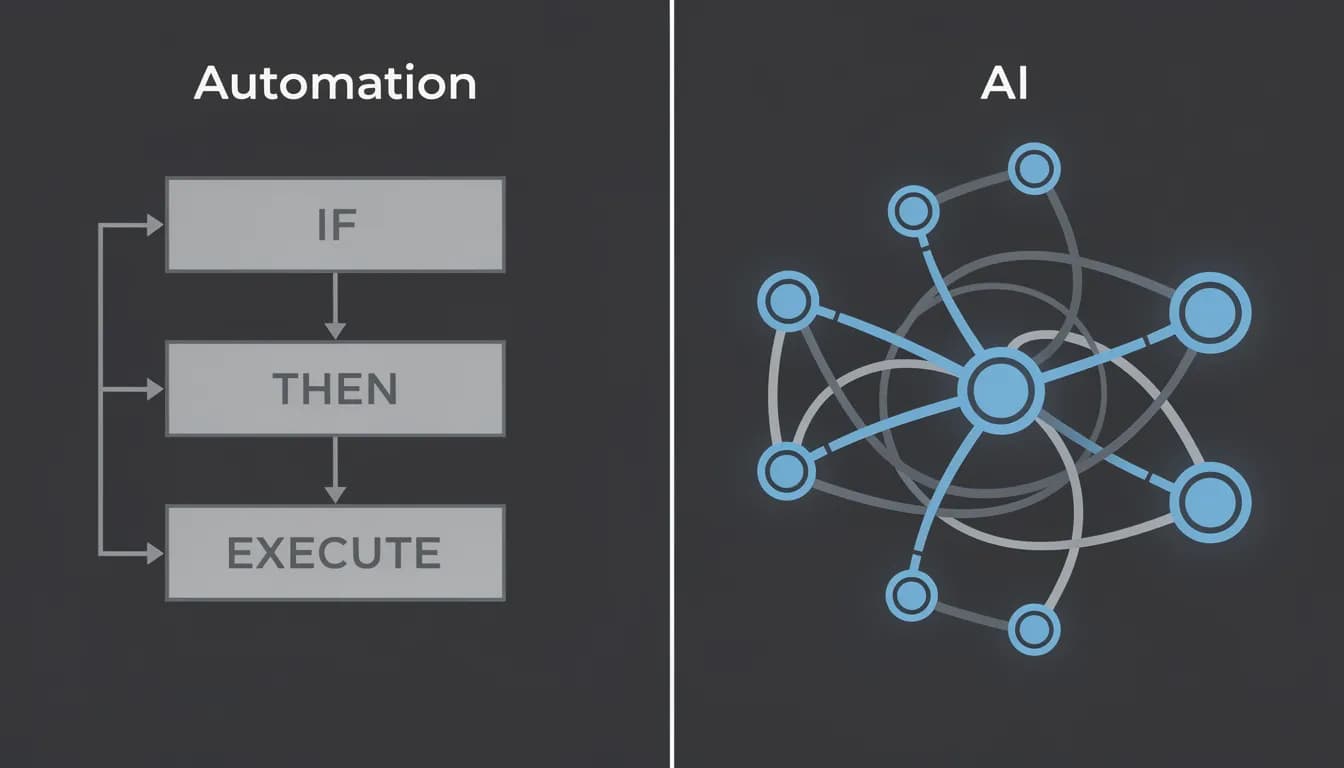
Marketing managers are being told they need "AI" in their stack — while also managing a growing collection of automation tools that are being re-branded as AI. The result is budget allocated to tools with overlapping promises, teams unclear on what actually requires human judgment and what doesn't, and a real risk of automating decisions that shouldn't be automated at all. The distinction matters more than the vendors want you to think.
The Plain-Language Difference
Marketing automation executes predefined rules and sequences without requiring new information. You define the logic once; the tool executes it every time the conditions are met. It's fast, reliable, scalable — and it can only do what you already know how to do.
Examples: An email sequence that sends a welcome message when someone signs up. A social post scheduled for Tuesday at 9 AM. A lead assigned to a sales rep when their score hits 80. These work perfectly — as long as the rules cover every scenario correctly, and the world doesn't change.
AI in marketing applies machine-learned models to generate, evaluate, or decide — tasks that require processing new patterns, ambiguous inputs, or open-ended outputs. It's not executing your rules. It's doing something closer to reasoning.
Examples: Writing a first draft of a blog post. Evaluating which ad creative is likely to perform best with a new audience segment. Deciding which prompt about your brand category triggers a positive mention in ChatGPT. Classifying whether a 200-word product description is better than the current version.
The core difference: automation does what you tell it. AI does what you'd have to think about.
Rule-Based Automation in Marketing: What It's Actually Good At
Automation tools (Make, Zapier, n8n, HubSpot Workflows, Marketo) genuinely excel at repeatable, rule-based sequences where the logic is already clear:
Email nurture sequences: A prospect downloads an ebook → trigger a 5-email sequence over 14 days. The content is human-written. The timing and trigger are automated. This is not AI. It works extremely well and doesn't need to be.
Social media scheduling: Content calendar items posted at optimal times based on historical engagement windows. Automation handles the publishing logistics; humans (or AI) handle the content.
Lead scoring and routing: When a lead visits the pricing page three times within 7 days, score +20 and alert the relevant sales rep. Pure rule-based logic — automation is ideal.
CRM data updates: When a deal moves to "Proposal Sent" in Salesforce, trigger a task for follow-up in 3 days, update the contact's lifecycle stage, add them to a LinkedIn Matched Audience. All rule-based. All perfectly suited to automation.
Where automation breaks down: The moment the rules have too many exceptions, the inputs are ambiguous, or the output requires a judgment call that the rule-writer couldn't anticipate. Automation doesn't know what to do when the rules don't fit.
AI in Marketing: Where It Earns Its Place
AI tools handle the parts of marketing that require processing new information, evaluating open-ended outputs, or making decisions across too many variables for rules to cover reliably:
Content generation: Drafting blog posts, ad copy, product descriptions, email subject lines. AI generates plausible first drafts across an enormous range of inputs — faster than any rule-based system could produce varied creative output.
SERP and AI search analysis: Evaluating what AI engines currently say about your brand, identifying content gaps, analyzing competitor coverage patterns. This is pattern recognition across messy, varied data — the kind of task AI handles better than any rule system.
Ad creative optimization: Predicting which ad headline is most likely to resonate with a specific audience segment based on historical performance patterns. The variable space is too large for human rule-writing; ML models trained on performance data genuinely outperform manual selection.
Personalization at scale: Determining which content variant to show a specific visitor based on behavioral signals, session context, and predicted intent. Rule-based personalization handles 3–4 segments; AI-powered personalization handles thousands.
Agentic search visibility management: Monitoring and optimizing how your brand appears when AI agents — not humans — research your product category. No rule-based automation can do this; it requires AI evaluating AI outputs.
Where Automation and AI Overlap: AI-Powered Automation
The most powerful marketing stack combines both — and the category doing it is called AI-powered automation (or agentic marketing).
The pattern: AI handles the judgment call; automation handles the execution. Neither alone is as capable as the combination.
Example 1 — Content pipeline: AI writes a draft blog post based on a keyword brief → automation triggers the review workflow → AI scores the draft against brand guidelines → automation routes it to the right editor → AI generates image prompts → automation publishes to CMS on approval.
Example 2 — Ad optimization: AI evaluates creative performance data weekly → identifies the underperforming ad sets → automation pauses those ad sets and triggers the creative team's brief template → AI generates three alternative headline variants → automation creates the new ads in draft.
Example 3 — AI visibility monitoring: Allable monitors your brand's mentions across 7 AI engines automatically (automation layer) → uses AI to evaluate sentiment and accuracy of each mention → triggers a content recommendation workflow when coverage gaps or inaccuracies are detected → the marketing team reviews the recommendations and approves content briefs.
This is where AI visibility optimization operates as a discipline: it requires AI (to evaluate AI search outputs) wrapped in automation (to run the monitoring, reporting, and workflow triggers systematically).

Decision Framework: Automation or AI?
Use this table to decide which tool type fits your task:
Task Characteristic | Automation | AI |
|---|---|---|
Rules can be fully pre-specified | ✅ Best fit | ❌ Overkill |
Output is always one of a known set | ✅ Best fit | ❌ Overkill |
Task repeats identically at scale | ✅ Best fit | Can work |
Input varies significantly each time | ❌ Breaks down | ✅ Best fit |
Judgment or creativity required | ❌ Can't do it | ✅ Best fit |
Processing new, unanticipated data | ❌ Can't do it | ✅ Best fit |
Speed and precision are the goal | ✅ Best fit | Can work |
Accuracy on ambiguous data matters | ❌ Risky | ✅ Best fit |
Quick heuristic: If you can write the logic in an if/then flowchart and it will still be correct in 6 months, automate it. If the logic requires "it depends" for more than 20% of cases, you need AI — or a human.

Tools: A Marketing-Focused Comparison
Automation platforms:
- Make (formerly Integromat) — visual workflow builder, excellent for multi-step marketing sequences. Best for: CRM updates, notification triggers, data routing across tools.
- Zapier — the most user-friendly option for non-technical marketers. Connects 6,000+ apps. Best for: simple 2–3 step triggers between tools your team already uses.
- n8n — open-source, self-hostable, more complex workflows. Best for: technical marketing teams that want full control without per-task pricing at scale.
- HubSpot Workflows / Marketo Engage — automation built into CRM/MAP. Best for: teams already invested in HubSpot or Marketo who need native workflow logic.
AI marketing platforms:
- ChatGPT / Claude — general-purpose AI assistants. Excellent for drafting, brainstorming, analysis. Not natively connected to your data or workflows.
- Jasper / Copy.ai — AI writing tools with brand voice training. Best for: teams that need high-volume content output with brand brand consistency controls.
- Allable — AI visibility and content marketing platform. Combines AI-powered monitoring of brand mentions across 7 AI engines with content optimization and automated workflow triggers. Best for: marketing teams that need to manage brand presence in AI search as a systematic discipline.
The integration layer:
The most capable setups use automation platforms (Make, n8n) to connect AI tools to your broader stack — so AI outputs automatically feed into CRM records, content calendars, Slack alerts, and CMS workflows. That's the AI-powered automation pattern in practice.
Frequently Asked Questions
- Is automation being replaced by AI?
- No — they solve different problems. Automation has become more powerful as AI tools improve (because AI can now handle the exception cases that break pure automation). But the underlying need for reliable, rule-based sequence execution hasn't gone away. The most effective marketing teams use both.
- Can I use Zapier for AI tasks?
- Zapier now includes native AI actions (via OpenAI integrations and Zapier Central). These are AI-powered automations — the AI handles a specific generation or classification task within a Zapier workflow. For simple use cases (auto-classifying support emails, generating one-line summaries), this works well. For complex marketing AI use cases (brand visibility monitoring, campaign optimization, content strategy), you'll need dedicated AI marketing platforms.
- What's the cheapest way to add AI to my marketing stack?
- Start with ChatGPT Pro ($20/month) for content drafting, analysis, and brainstorming. Use Zapier or Make's free tier to automate the execution of outputs (post-approved drafts to CMS, trigger review workflows). Add specialized tools only when the general-purpose AI hits consistent limits for a specific task. This gives you 80% of the capability before committing to expensive platform contracts.
- Is Allable an automation tool or an AI tool?
- Allable is both — it's an AI-powered automation platform for brand visibility in AI search. The monitoring layer (running prompts across 7 AI engines on a defined schedule) is automation. The analysis layer (evaluating brand mentions, calculating SOMV, identifying content gaps) is AI. The workflow layer (triggering recommendations, updating dashboards, surfacing alerts) is automation again. It's the AI-powered automation pattern applied specifically to the AI visibility optimization use case.
- How do I know if a task needs AI vs automation?
- Ask yourself: 'Could I write out every possible scenario in an if/then flowchart?' If yes — and if the flowchart will still be correct next month — use automation. If the task involves evaluating open-ended inputs, generating creative outputs, or making decisions across too many variables to enumerate, use AI. Most real marketing workflows eventually need both.
See How Allable Combines AI and Automation
Allable is the AI-powered automation platform built for marketing teams — connecting AI visibility monitoring, content optimization, and workflow triggers in one place. Stop choosing between automation and AI; use both in the same platform.