
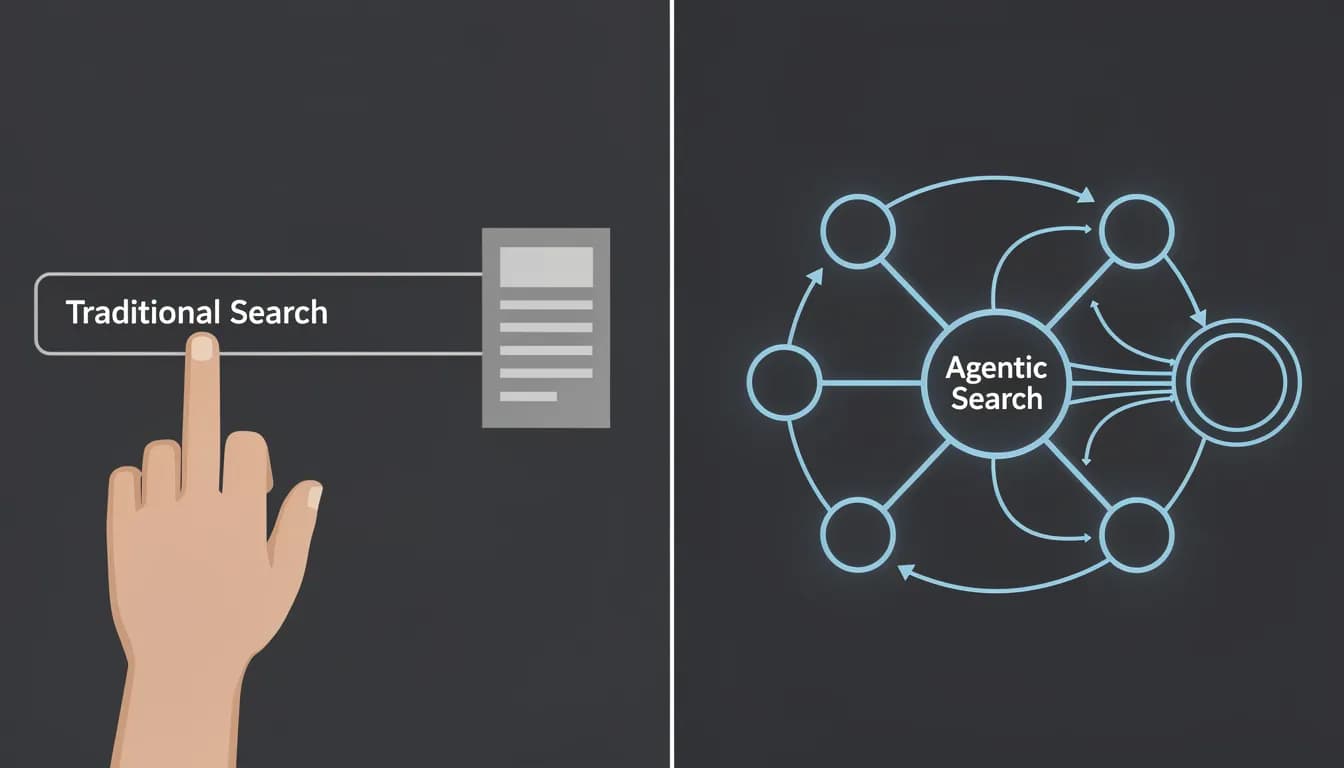
When you searched Google this morning, you were the searcher. When your customer used ChatGPT Deep Research to evaluate vendors last week — an AI agent was the searcher. Two completely different systems, completely different ranking criteria, and your team is probably only optimizing for the first one. Agentic search is growing faster than any other search format in 2026. And the brands winning in it aren't the ones with the highest Domain Authority. They're the ones whose content is structured for machine retrieval, not human scanning. When was the last time your SEO strategy accounted for an AI agent as the audience?
What Is Agentic Search?
Agentic search is what happens when an AI agent — rather than a human — executes a search query on your behalf. Instead of a person typing "best AI marketing tools" into Google, an AI agent receives a broader task ("help me find and compare the top AI marketing platforms for a 20-person SaaS company"), breaks it into multiple sub-queries, retrieves content from across the web, synthesizes the results, and returns a structured recommendation.
The AI agent is both the searcher and the summarizer. It decides which sources to retrieve, which to trust, and which to cite in its output.
Examples you may already be using without thinking of them as "agentic search":
- ChatGPT Deep Research: user gives a task → GPT-4o autonomously researches across the web → returns a cited report
- Perplexity Pages: builds long-form research documents from live web retrieval
- Google Gemini Pro: executes multi-step research workflows in Google's AI suite
- Microsoft Copilot: handles enterprise research tasks using Bing retrieval
Key distinction from conversational AI: agentic search retrieves live content from today's web. It doesn't rely only on training data. That means your content — if structured correctly — can be in an agentic search output today, regardless of when the model was trained.
How Agentic Search Is Different From Traditional Search
Traditional search is a human process. A person has a question, types it in, scans a list of 10 results, and clicks on the one that looks most relevant.
Agentic search is a machine process. The user states a goal. The AI agent determines what sub-questions to ask, retrieves content from multiple sources, evaluates which sources are most credible and relevant, and synthesizes a unified answer — often with citations but no expectation that the user will click through to read anything.
This changes the competitive landscape in three critical ways:
The agent decides what to cite, not the user. In traditional search, a user's click behavior reflects their preference. In agentic search, the agent's citation reflects its assessment of source quality. Your brand doesn't get the benefit of an attractive title or a compelling snippet preview.
Zero-click is the default. Traditional SEO has been dealing with zero-click search for years (Featured Snippets, People Also Ask). In agentic search, zero-click is nearly universal — the agent synthesizes the answer and delivers it. Brand visibility comes through citation, not click.
The research is multi-step. A prospect using ChatGPT Deep Research to evaluate your product category might run 20 sub-queries, synthesizing a competitor comparison, pricing analysis, and user review summary — all before your sales team knows they exist. If your brand appears in that output, you're in the consideration set. If you don't, you were never evaluated.
How Agentic Search Agents Decide What to Cite

Understanding the citation decision is the foundation of agentic search optimization. AI agents don't rank sources the way Google does. They select sources using a different — and in some ways more demanding — set of criteria.
Retrieval relevance. The agent starts by retrieving pages that are semantically relevant to its sub-query. Traditional SEO signals (indexing, crawlability, keyword relevance) still matter at this stage — you need to be in the candidate pool.
Structural clarity. From the candidate pool, agents prefer content that is cleanly extractable. Clear H2/H3 headings that function as questions, definition-style opening paragraphs, numbered step lists, and comparison tables all make it easier for an agent to pull a specific answer without reading your entire page. Walls of unstructured prose get passed over.
Source trust signals. Agents weight domain authority, freshness, and author credibility. Pages with named authors, linked credentials, cited external sources, and recent publication or update dates score higher in the agent's trust evaluation.
Entity recognition. For brand mentions specifically, agents rely on entity recognition — whether your brand name, category, and core description are consistent and recognizable across the web. A brand that is described differently on its own site, G2, LinkedIn, and press mentions creates entity ambiguity that reduces citation confidence.
Citation diversity pressure. AI agents are designed to avoid over-reliance on a single source. If your content is the only source covering a topic, the agent may still cite you — but you're more likely to be cited consistently if multiple high-authority sources corroborate your claims.
The practical implication: entity optimization and LLM citation strategy are prerequisites for agentic search visibility, not nice-to-haves.
What Agentic Search Means for Your Marketing Team
This isn't a trend to put on your Q4 roadmap. If your ICP includes B2B buyers, technical evaluators, or any segment that uses AI tools for research — agentic search is affecting your brand perception right now.
You're losing evaluations you don't know exist. A prospect using ChatGPT Deep Research to evaluate vendors in your category will reach a recommendation before your SDR sends a first email. If your brand isn't cited in that output, you weren't evaluated — you were absent.
Agentic search is your biggest zero-click exposure. You've been watching AI Overviews reduce click-through rates in Google. Agentic search is a more extreme version of the same dynamic. The entire research workflow happens inside the AI tool. Brand visibility = being cited in the output, period.
Comparison content is your highest-leverage format. AI agents actively look for "X vs Y" structures when conducting competitive research. A well-structured, agent-readable comparison of your product against competitors is the single most valuable content type for agentic search visibility. The agent will use it — and cite you as the source.
Original research gets cited disproportionately. AI agents are trained to prefer primary sources. Your own data, surveys, customer benchmarks, and proprietary research are more likely to be cited than a summary of someone else's study. If you have original data, package it for machine extraction.
6 Ways to Optimize for Agentic Search

1. Add structured data and FAQ schema to all key pages
FAQ schema is the fastest-acting technical change you can make for agentic search visibility. It packages your content in a structured question-answer format that agents extract with high confidence. Every page covering a category-level question — "what is," "how to," "best options for" — should have FAQ schema.
2. Create clear, extractable definitions of your category
Agents need to be able to answer "what is [your category/product]?" accurately from your content. Write a 2–3 sentence definition of your product category, your brand's position in it, and your core differentiator. Make it the opening paragraph of your About page, your homepage hero, and your CMS meta description. Consistency across all three signals entity clarity to retrieval systems.
3. Build comparison content — agents love "vs" structure
Create dedicated comparison pages for your brand against the top 3–5 competitors in your category. Structure them with a clear verdict section, a feature comparison table, and a use-case recommendation. These pages are retrieved in almost every agentic competitive research session for your category, and they put you in the author position — which influences how the agent frames the comparison in its output.
4. Publish original research tied to your brand
Commission a survey. Analyze your product data for industry benchmarks. Publish a state-of-the-market report. Any original data that gets picked up and referenced by other publications earns you a citation multiplier — the agent cites you not just for the data itself but whenever someone cites the study you authored.
5. Earn citations in sources agents trust
Identify which publications appear most frequently in AI-cited sources for your category — they show up as source links in Perplexity and Google AI Mode outputs. Target those outlets for coverage: press mentions, expert quotes, review inclusion. A single citation in Search Engine Journal or G2 provides more agentic search value than 50 directory links.
6. Monitor your brand in agentic outputs
You can't improve what you don't measure. Run your top 20 category queries through ChatGPT Deep Research and Perplexity weekly. Track whether your brand is cited, how it's described, and where competitors appear instead of you. Platforms like Allable and AI visibility tools built for this purpose automate the monitoring at scale, tracking your brand's appearance across 7 AI engines and surfacing citation gaps week over week.
Frequently Asked Questions
- Is agentic search the same as AI search?
- Not exactly. AI search is any search experience where an AI model is involved in generating or summarizing results — this includes Google AI Overviews and basic ChatGPT questions. Agentic search specifically refers to AI agents that execute multi-step, autonomous research workflows: breaking a goal into sub-queries, retrieving from multiple sources, and synthesizing an answer. Agentic search is more complex, more autonomous, and more influential in B2B research workflows than standard AI search.
- How does an AI agent decide what to include in a search result?
- The citation decision involves: (1) retrieval relevance — is the page topically relevant to the sub-query? (2) structural clarity — can the agent cleanly extract a specific answer? (3) source trust — is the author credible, the domain authoritative, the content fresh? (4) entity recognition — is the brand or organization clearly identified and consistently described? Pages that score well on all four criteria get cited; pages weak on any one often get skipped in favor of cleaner alternatives.
- Does Google's AI Mode count as agentic search?
- Yes — Google AI Mode operates as a multi-step research agent. When you use AI Mode in Google Search, the system breaks your query into sub-questions, retrieves content across multiple searches, and synthesizes a response. The citation patterns and optimization strategies for Google AI Mode are closely aligned with what works for ChatGPT Deep Research and Perplexity Pages.
- How do I track my brand's agentic search visibility?
- Start with manual sampling: run your 20 most important category queries through ChatGPT (with search enabled), Perplexity, and Google AI Mode, and record whether your brand appears. For ongoing tracking, Allable monitors brand citations across ChatGPT, Perplexity, Google AI Overviews, and Google AI Mode — calculating your Share of Model Voice against named competitors and surfacing citation gaps in a weekly dashboard.
- Will agentic search replace traditional SEO?
- No — but the balance is shifting. Traditional SEO still drives significant traffic for transactional and navigational queries. Agentic search is growing fastest for research-intent, comparison, and evaluation queries — exactly the queries that matter most in B2B sales cycles. The practical answer: you need both. Traditional SEO gets you into the candidate pool that agentic search agents retrieve from. AVO strategy determines whether you get cited once you're in that pool.
Track Your Brand in Agentic Search
Allable monitors your brand citations across ChatGPT, Perplexity, Google AI Mode, and 4 other AI engines — surfacing citation gaps and Share of Model Voice week over week.