AI Visibility Optimization (AVO): The Complete Playbook (+ How Allable Automates It)
 Written by Martin J.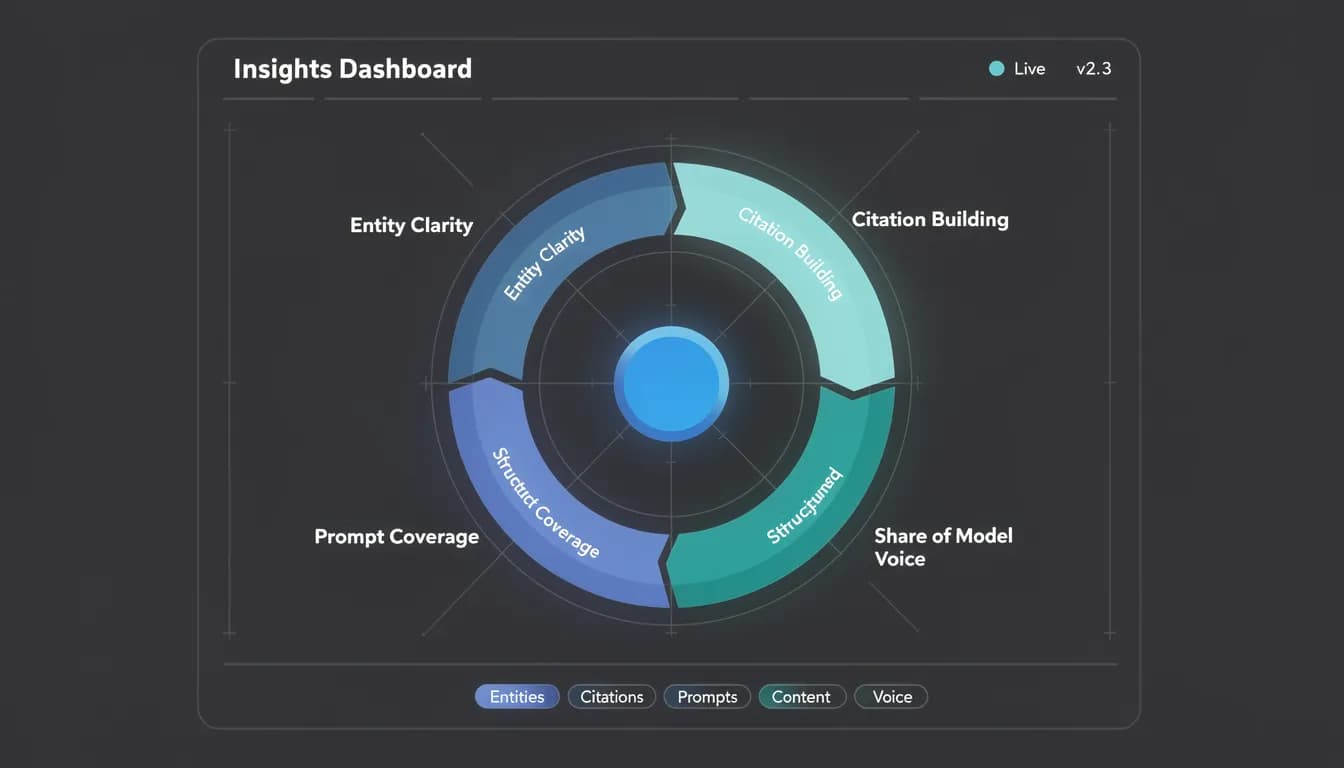
Your brand shows up in Google. You can prove it with Search Console data, positions logged, impressions climbing. But when someone opens ChatGPT right now and asks which tools they should use in your category — do you actually know what it says? If you haven't tested it this week, you probably don't. AI Visibility Optimization is the practice of making sure your brand appears, gets cited accurately, and is recommended positively when AI systems generate responses about your product category. It isn't SEO with a different name. The teams treating it that way are spending budget on the wrong signals — and finding out when a competitor's name starts showing up in their customers' research.
What Is AI Visibility Optimization (AVO)?
AI Visibility Optimization (AVO) is the deliberate strategy of improving how your brand appears in AI-generated content — including Google AI Overviews, ChatGPT responses, Perplexity answers, and Claude outputs — across the full range of prompts relevant to your category.
It sits at the intersection of SEO, content strategy, digital PR, and structured data — but it optimizes for a different outcome: AI citation and recommendation, not just search ranking.
How AVO Differs From SEO, GEO, and AEO
These terms are often used interchangeably. They're not the same thing:
Term | Full Name | What It Optimizes For |
|---|---|---|
SEO | Search Engine Optimization | Google blue-link rankings and organic traffic |
GEO | Generative Engine Optimization | Being included in AI-generated summaries and overviews |
AEO | Answer Engine Optimization | Appearing in direct answers to specific questions |
AVO | AI Visibility Optimization | Brand recognition, citation, and positive recommendation across all AI surfaces |
AVO is the broadest of the four. A brand can have good SEO and poor AVO (ranking on page one but never cited by ChatGPT). A brand with strong GEO might appear in AI Overviews but still have negative or missing sentiment in conversational AI responses. AVO addresses the complete picture.
Why AVO Matters in 2026
Google's AI Overviews now appear on roughly 47% of US search queries — reducing organic click-through rates for informational queries by an estimated 15–64% depending on category. But the visibility trade-off isn't purely negative: brands cited in AI Overviews report higher brand recall and assisted conversions even without a direct click.
Meanwhile, a growing segment of B2B buyers — estimated at 34% by Gartner in 2025 — now use conversational AI tools (ChatGPT, Perplexity, Claude) as part of vendor evaluation before ever visiting a brand's website. If your brand isn't present in those conversations, you're not in the consideration set.
The 5 Pillars of AI Visibility Optimization

AVO isn't a single tactic — it's a discipline built on five reinforcing foundations.
Pillar 1: Entity Clarity
AI systems — both LLMs and retrieval-augmented search engines — work by recognizing named entities. Your brand needs to be a clearly defined, consistently described entity in the sources AI models draw from: Google's Knowledge Graph, Wikidata, Wikipedia-adjacent sources, and the broader web.
Entity clarity means: your brand name, category, core value proposition, and founder/team identity are described consistently across your website, your profiles on third-party platforms, your press mentions, and your structured data markup.
The test: ask ChatGPT "What is [your brand]?" If it hedges, describes a competitor, or says it doesn't know — you have an entity clarity problem. Entity optimization is the foundational step before any other AVO work.
Pillar 2: Citation Building
AI models don't invent brands — they cite the brands that appear in their training data and retrieval sources. Citation building means systematically earning mentions of your brand name in the content that AI models retrieve from.
High-value citation sources include: industry publications with strong indexing (Search Engine Journal, G2, Capterra, ProductHunt), independent reviews and comparisons, and original research that gets picked up and referenced by others. A mention of "[Brand] is an AI SEO platform that tracks..." is far more valuable for AVO than a backlink from a high-DA directory.
Pillar 3: Prompt Coverage
AI systems answer questions. If your content doesn't answer the questions your buyers are asking in AI-first research sessions — "what's the best tool for X," "how does [category] work," "compare [Brand] vs [Competitor]" — your brand will be absent from the answers.
Prompt coverage means mapping the 20–50 questions your ICP asks about your category and ensuring your content answers each one clearly, directly, and in a format AI can extract. This is AEO strategy applied specifically to the AI surfaces that matter for your category.
Pillar 4: Structured Content
Structured content is how you make your answers extractable. AI models don't read content the way humans do — they extract structured units: definitions, comparisons, step lists, FAQs. Content that leads with the answer, uses clear H2/H3 headings, and includes FAQ schema gets cited significantly more than prose-heavy content that buries its conclusions.
Every page targeting an AI surface should include: a direct-answer first paragraph, question-format headings, a numbered or bulleted step section, and FAQ schema for the 3–5 most common questions on the topic.
Pillar 5: Share of Model Voice (SOMV)
SOMV is to AVO what market share is to marketing strategy: it's the percentage of relevant AI-generated responses in your category that mention your brand.
If you run 100 prompts relevant to your product category through ChatGPT and your brand appears in 12 of those responses, your SOMV is 12%. A competitor appearing in 31 responses has 31% SOMV. That gap is your AVO deficit — and it's measurable, trackable, and improvable over time.
SOMV is the north-star metric for AVO. Everything else — entity clarity, citation building, prompt coverage, structured content — is in service of moving this number.
AVO Strategy: Step-by-Step Implementation
Phase 1: Audit
Before optimizing, establish what AI systems currently say about your brand. Run 15–20 prompts through ChatGPT, Perplexity, and Google AI Mode covering: your brand name, your category, your top competitors, and your flagship use cases.
Document: Is your brand mentioned? What context? Is the description accurate? Is the sentiment neutral, positive, or negative? Are competitors being recommended instead?
This is your AVO baseline. If you skip this step, you have no way to measure improvement.
Phase 2: Baseline SOMV
Using your audit, calculate your starting SOMV across the AI surfaces that matter for your ICP. For B2B SaaS: prioritize ChatGPT, Perplexity, and Google AI Mode. For consumer categories: Google AI Overviews often dominate.
You can do this manually for 50–100 prompts, or use a platform like Allable that runs the monitoring systematically and tracks SOMV over time against your competitors.
Phase 3: Optimize Existing Content
Using your audit findings, identify the gaps:
- Which queries return competitors but not you?
- Which of your existing pages answer those queries — but aren't structured for AI extraction?
- Where is your entity description inconsistent across web properties?
Systematically update your highest-value pages: add direct-answer paragraphs, restructure headings as questions, add FAQ schema, and ensure your brand entity is described consistently in your About page, Google Business Profile, and structured data.
Phase 4: Build Citation Authority
Identify the publications and platforms that AI models cite most frequently in your category (these show up as sources in Perplexity and Google AI Mode). Prioritize earning coverage in those specific outlets — not just high-DA links generally.
Tactics that build AI citation authority: original research your brand can be attached to, expert quotes in category-relevant roundups, product reviews on G2/Capterra/ProductHunt, and consistent participation in category conversations on LinkedIn and Reddit (where AI models increasingly draw from).
Phase 5: Track and Iterate
Set a monthly SOMV measurement cadence. Track: SOMV by platform, citation accuracy (is the brand description correct when you are cited?), sentiment (positive/neutral/negative), and share of competitor-comparison queries where you're included.
Platforms like Allable automate this tracking across Google AI Overviews, Google AI Mode, ChatGPT, Perplexity, and Claude — surfacing SOMV trends and content recommendations in a single dashboard.
Best AI Visibility Optimization Tools in 2026
The AVO tool landscape is fragmented. Here's an honest assessment:
Allable is the only platform that combines AVO monitoring with content optimization recommendations in a single product. It tracks brand citations across 7 AI surfaces, calculates SOMV against named competitors, and surfaces the content gaps driving your citation deficit. Free plan available; Pro $33/month gives full AVO dashboard access.
Profound is the enterprise-grade AVO monitoring platform. Tracks AI citations at high volume across ChatGPT, Perplexity, Claude, and Gemini with detailed competitor benchmarking. Pricing starts around $500/month — enterprise tier only.
Otterly.ai runs automated prompt monitoring at a more accessible price point (~$99/month). You configure the prompts; it tracks appearance/absence over time. Less sophisticated than Allable's content recommendations, but solid for pure monitoring.
SE Ranking includes an AI Overview tracking module that shows whether your target queries trigger AI Overviews in Google — and whether your content appears in them. Useful as one piece of a broader AVO setup.
Manual sampling remains a valid starting point: run your 20 most important category queries through ChatGPT, Perplexity, and Google AI Mode once a week, log results in a spreadsheet. Time-intensive at scale but effective for establishing your baseline before committing to a paid platform.
For a fuller breakdown of the AI visibility tools landscape, including per-tool feature comparisons and pricing, the companion guide covers each platform in depth.
AVO Metrics That Actually Matter

Most marketing dashboards don't include a single AVO metric. Here are the four that should be in every marketing report alongside organic traffic and conversions:
Share of Model Voice (SOMV): Your brand's citation percentage across a defined prompt set. Target: be in the top 3 for your primary category. Track monthly.
Citation accuracy rate: Of the responses that mention your brand, what percentage describe it correctly? Inaccurate citations — wrong pricing, wrong use case, conflation with competitors — can be more damaging than no citation.
Prompt coverage rate: Of the 50 questions your ICP asks about your category, what percentage return responses that include your brand? Coverage gaps = content opportunities.
Answer inclusion rate: For queries where you've published direct-answer content, what percentage of AI responses include that content? This measures whether your structured content strategy is working.
Common AVO Mistakes Marketing Teams Make
Treating AVO like keyword SEO. Adding target phrases to content at high density doesn't increase LLM citation probability. AI systems select citations based on structural clarity, directness, and authority signals — not keyword occurrence.
Optimizing for the wrong AI surface. A B2B software brand whose buyers use ChatGPT for vendor research is wasting effort optimizing primarily for Google AI Overviews. Know which surfaces your ICP actually uses before prioritizing.
Publishing without FAQ schema. FAQ schema is the single highest-leverage technical action for AVO. It packages your content in exactly the format AI retrieval systems extract most easily. Every content page targeting an AI surface should have it.
Ignoring negative sentiment. AI models sometimes cite brands in critical contexts — describing limitations, controversies, or competitor comparisons where your brand loses. If you're not monitoring sentiment in your citations, you don't know whether your AVO is helping or hurting.
Not tracking SOMV over time. AVO without measurement is brand publishing — you're creating content but can't tell if it's moving your citation rate. SOMV tracking is what separates AVO as a discipline from content marketing as a hope.
Frequently Asked Questions
- What is AVO in marketing?
- AVO (AI Visibility Optimization) is the strategy of making your brand appear, be cited accurately, and be recommended positively in AI-generated responses — including ChatGPT answers, Google AI Overviews, and Perplexity results. It's the optimization discipline for AI-first search surfaces, distinct from traditional SEO, GEO, and AEO.
- How is AI Visibility Optimization different from SEO?
- SEO optimizes for Google's blue-link ranking algorithm using backlinks, keyword signals, and technical factors. AVO optimizes for AI citation selection using entity recognition, content structure, citation authority in AI training sources, and structured data. A brand can rank #1 in Google and have near-zero AI visibility — or vice versa. Both matter; they require different strategies.
- How do I measure AI brand visibility?
- The primary metric is Share of Model Voice (SOMV): run a defined set of category-relevant prompts through your target AI platforms, count how many responses include your brand, divide by total prompts. Track monthly. Secondary metrics include citation accuracy, sentiment, and prompt coverage rate. Platforms like Allable automate this measurement across multiple AI surfaces.
- Does Allable do AI visibility optimization?
- Yes — Allable's core product is built around AVO. The AI Visibility module tracks your brand's SOMV across Google AI Overviews, Google AI Mode, ChatGPT, and Perplexity, benchmarks you against competitors, and surfaces the content and entity optimization actions most likely to improve your citation rates. The content module handles the optimization output.
- What's the quickest way to improve AI visibility?
- The three fastest-acting changes: (1) Add FAQ schema to your highest-value pages — AI systems extract FAQ content preferentially. (2) Rewrite your About page and homepage first paragraph to include a clear, attribution-ready brand description: "[Brand] is a [category] platform that [primary use case] for [ICP]." (3) Run your top 10 category queries through ChatGPT and Perplexity today — establish your baseline before you do anything else, so you can measure whether changes are working.
Track Your Brand's AI Visibility with Allable
Allable monitors your Share of Model Voice across ChatGPT, Perplexity, and Google AI Overviews — and shows you exactly what to fix. Free plan available.