Agentic AI vs AI Agents: What's the Difference? (And Why It Matters for Your Marketing Stack)
 Written by Martin J.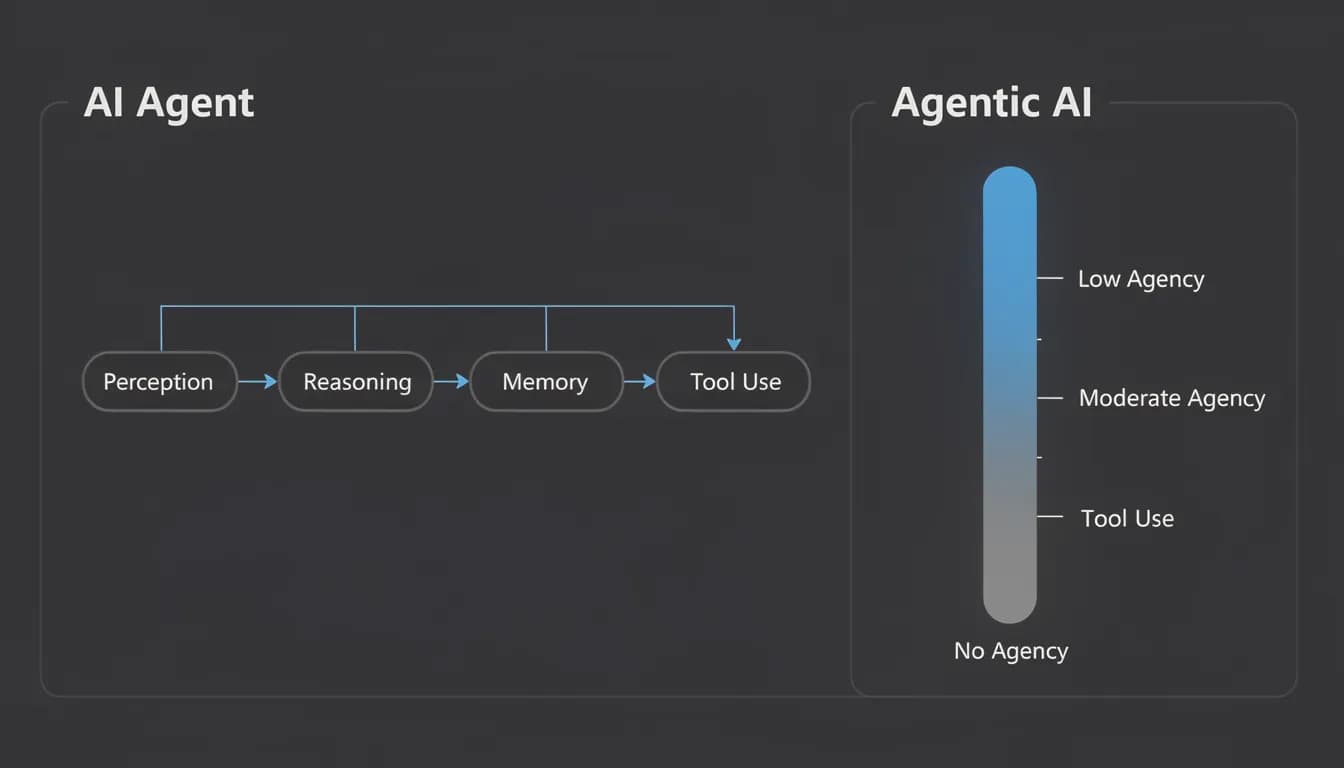
Every AI vendor is now 'agentic.' Some mean their chatbot remembers your name. Others mean their platform can autonomously run a multi-week marketing campaign. The word is doing too much work — and it's making it genuinely difficult to evaluate tools that claim the same label. Here's the actual distinction between agentic AI and AI agents, why the difference matters when you're building or buying a marketing AI stack, and where the real capability boundary lies.
The Terminology Problem: Why This Gets Confusing So Fast
'Agentic' became the AI industry's favourite adjective somewhere around late 2023 — and it hasn't recovered a coherent meaning since.
The problem is structural. 'AI agents' and 'agentic AI' are genuinely distinct concepts from different parts of computer science: one is an architectural pattern, the other is a behavioral property. But in marketing copy, they get collapsed into a single vague signal meaning 'more powerful than last year's AI.' The result is that your sales rep uses 'agentic' to mean memory retention, your competitor uses it to mean autonomous campaign execution, and both are technically defensible.
Three terms are doing real work in this space, and they're worth separating before anything else:
- AI agent — an architectural pattern: a software system that perceives inputs, reasons about what to do, and takes actions using external tools. This is a how-it's-built concept.
- Agentic AI — a behavioral property: the degree to which an AI system can pursue goals autonomously over time, without requiring a human at every decision point. This is a how-it-behaves concept.
- Generative AI — a capability type: AI that produces new content (text, images, code) in response to prompts. This is a what-it-outputs concept.
These aren't synonyms. A system can be built with AI agents but have zero agentic behavior if a human approves every action. A generative AI model can become part of an agentic AI system without itself being 'agentic.' And most of the tools you're evaluating probably combine all three in ways the vendor's marketing page doesn't explain clearly.
The confusion costs you. When you equate 'agentic' with 'uses AI,' you can't distinguish between tools that fundamentally differ in what they require from you — and that gap is the difference between a tool that automates work and one that still requires you to orchestrate every step.
What Is an AI Agent? (The Technical Concept, in Plain English)
An AI agent is a software system built around a loop: perceive → reason → act → observe → repeat.
The formal definition from computer science says an agent is any system that perceives its environment through inputs, makes decisions based on what it perceives, and takes actions that affect that environment. What makes modern AI agents different from traditional rule-based systems is the reasoning step: instead of following fixed logic ('if condition A, do B'), an AI agent uses a language model or similar system to reason about what the right next action is, given the current state of the task.
This reasoning flexibility is what makes AI agents genuinely useful. The five components you'll see in most agent architectures:
- Perception layer — the agent receives inputs: text, data, tool outputs, memory retrievals
- Reasoning / planning — a language model decides what to do next, often breaking goals into sub-tasks
- Memory — short-term context (the current task) and long-term storage (past results, learned preferences)
- Tool use — the agent can call external systems: search APIs, databases, CMS platforms, ad accounts
- Action execution — the agent actually does something: writes a file, sends a query, creates a post
Here's what this looks like at three different complexity levels — because 'AI agent' spans a wide range:
Simple agent: ChatGPT with web search When you ask ChatGPT with a search tool to 'find the latest data on email open rates,' it perceives your query, decides to run a web search, retrieves results, synthesises them, and responds. It uses one tool, completes one task, stops. That's an AI agent — a minimal one. It has no memory beyond the conversation, no persistence, and no ability to initiate follow-up actions unless you ask again.
Mid-complexity agent: Allable's keyword research agent When you ask Allable to research a content opportunity, its keyword research agent queries your KWS database for volume and difficulty data, pulls live SERP results for the target keyword, checks what's already in your content inventory, then returns a prioritised recommendation with supporting evidence. Multiple tool calls, coordinated in sequence, returning structured output that feeds the next step in your workflow. Still operating within a bounded task, but using several tools and maintaining state across steps.
Complex agent: a full agentic marketing pipeline A pipeline that takes a keyword brief and — without further human input — researches competitor coverage, drafts an article, generates supporting images, publishes a CMS draft, monitors indexing status, and flags when rankings move. This isn't a single agent; it's multiple AI agents working in sequence, each specialised, each feeding the next. This is where 'AI agent' as architecture and 'agentic AI' as behavior start to overlap.
The key distinction that matters for your evaluation: AI agents don't follow fixed rules — they reason about what to do next. That reasoning flexibility is what enables them to handle novel situations. It's also what makes them harder to predict than traditional automation, which is why the question of how much autonomy you give them matters.
What Is Agentic AI? (The Autonomy Spectrum)
If AI agents describe how a system is built, agentic AI describes how it behaves — specifically, how much it can accomplish without human intervention at each step.
'Agentic' is not a binary category. It's a spectrum, and where a system sits on that spectrum determines whether it's saving you hours or just generating another thing for you to review and manually act on.
Here are the four levels, with real examples your marketing team will recognise:
Level 1 — No Agency: Reactive Generation
Example: Asking ChatGPT to write five email subject lines.
The AI produces an output. You decide what to do with it. Nothing happens automatically. There's no follow-through, no next step the AI initiates, and no connection to any system that would execute anything. This is pure generative AI. The model is technically capable of more, but in this configuration it has zero agentic behavior — it responds when prompted and waits.
Most enterprise use of AI in 2024 operated at this level. Smart, useful, but requiring you to orchestrate everything downstream.
Level 2 — Low Agency: Tool Access, Human-Directed
Example: Copilot in Microsoft 365 writing a report draft based on your SharePoint files; ChatGPT Plugins; basic Zapier + AI integrations.
The AI can now access external data sources and perform discrete actions — pulling from your CRM, reading a document, running a calculation. But a human is still directing every meaningful step. You decide when to start, what to do with each output, and what happens next. The AI executes sub-tasks; you're the project manager.
This is where most 'AI-assisted' marketing tools sit in 2026 — and where most vendor claims of being 'agentic' quietly land, if you test them carefully.
Level 3 — Medium Agency: Multi-Step Execution with Checkpoints
Example: Claude with computer use; Devin running a coding task; an AI research workflow that completes a defined pipeline before returning results.
The system executes a sequence of steps toward a goal, handling decision-making along the way. It can encounter unexpected situations and adapt. But there are designed checkpoints where a human can review before the next phase executes — either by system design or because the task has natural approval gates.
This is the level where you start reclaiming meaningful time. Instead of directing each step, you set a goal and return when the task is complete. The human role shifts from orchestrator to reviewer.
Level 4 — High Agency: Sustained Autonomous Workflows
Example: Allable AI agents running a content research, brief, write, and publish pipeline; autonomous monitoring agents that detect ranking changes and flag recommendations without being asked.
The system pursues goals with goal-level instructions over sustained periods. It maintains context across tasks and sessions, initiates follow-up actions based on what it observes, connects to your actual stack (CMS, ad platforms, analytics), and reduces the human loop to high-stakes decision gates rather than operational approvals.
This is what 'agentic AI' actually means when it's working. You don't manage the steps — you manage the outcomes.
Why this precision matters: a system can have one AI agent with zero agentic behavior (Level 1), or it can have high agentic behavior built from dozens of specialised agents coordinating at Level 4. The number of agents doesn't determine agenticity — the autonomy level does. Calling a chat interface with memory 'agentic AI' is like calling a hammer a construction firm.

Agentic AI vs Generative AI: The Key Difference
The comparison that matters most for your 2026 marketing stack isn't agentic AI vs AI agents — it's agentic AI vs generative AI. These are the two modes of AI capability you're actually choosing between when you evaluate tools, and the operational gap between them is significant.
Generative AI is reactive. It creates outputs — text, images, code, summaries — when you prompt it. The value is in the output quality. The human provides the goal, structures the workflow, and acts on the output. Generative AI has no skin in the game beyond the moment of generation.
Agentic AI is proactive. It pursues goals by executing sequences of actions. The value is in what gets done, not just what gets produced. The human provides the goal and the constraints; the system figures out the steps, executes them, monitors results, and adapts.
The line is blurring in 2026 — almost every generative AI platform is adding agentic features (tool use, memory, multi-step execution). GPT-4o can run code. Gemini can search the web mid-conversation. Claude can operate computer interfaces. But adding tool access doesn't make a system agentic in any meaningful operational sense; it raises the ceiling on what a single prompted task can accomplish while leaving the orchestration burden with you.
The practical test: who's running the workflow? If you're still the project manager directing each step, you're using generative AI with tool access. If the system runs the workflow and brings you results, you're using agentic AI.
Dimension | Generative AI | Agentic AI |
|---|---|---|
Mode | Reactive — responds to prompts | Proactive — pursues goals |
Scope | Single-turn or short conversation | Multi-step, sustained tasks |
Memory | Usually session-only | Persistent across sessions |
Tool use | Optional, single tool calls | Core — multi-tool coordination |
Human role | Orchestrator of every step | Reviewer of outcomes |
Output type | Content, answers, drafts | Completed workflows, actions |
Example | "Write me a blog intro" | "Research, draft, and schedule a post series on [topic]" |
Marketing impact | Saves minutes per task | Saves hours per workflow |
The reason this distinction matters for your marketing budget: generative AI tools — even powerful ones — require human orchestration. Every campaign, every brief, every content piece still needs someone to connect the steps. Agentic AI reduces that coordination overhead structurally. The ROI question shifts from 'how good is the output?' to 'how much of the workflow runs without me?'

For a deeper look at what this shift means in practice, see what agentic marketing looks like in practice.
Real Marketing Examples: What Agentic AI Actually Does (and What It Doesn't)
The fastest way to calibrate your 'is this actually agentic?' test is with real marketing tasks. Here are four — three that qualify, one that doesn't.
Agentic AI Examples in Marketing Practice
Example 1 — Content gap analysis and briefing
You tell the system: "Find the top 10 ranking articles for 'AI SEO tools', identify gaps in our current coverage, and draft a brief for the highest-opportunity topic."
This is agentic. The system needs to run live SERP queries, cross-reference your existing content inventory, evaluate keyword difficulty against your domain's competitive position, identify a gap, and produce a structured brief with supporting data. It's a multi-step workflow involving several tool calls and intermediate reasoning steps. An agentic AI system executes all of this from a single goal-level instruction; a generative AI tool waits for you to come back with the SERP data yourself.
Example 2 — Ad performance monitoring and optimisation
Instruction: "Monitor my Google Ads performance daily, flag ad groups where CPA exceeds target by more than 20%, and generate copy revision suggestions with reasoning."
This is agentic — and specifically illustrates what the agentic AI vs automation tools distinction looks like in practice. Traditional automation can flag the threshold breach. Agentic AI can reason about why the CPA is high (audience mismatch, weak headline, landing page issue), generate contextually relevant copy alternatives, and do this continuously without being prompted each cycle.
Example 3 — AI search visibility monitoring
Instruction: "Track whether Allable appears in Perplexity and ChatGPT responses for key queries. Alert me when coverage changes. Identify which competitor sources they're citing instead."
This is agentic — and represents a category of task that didn't exist as a meaningful workflow category two years ago. Agentic SEO workflows increasingly include monitoring AI-generated search surfaces, not just Google rankings. The task requires periodic queries to external AI systems, comparison to prior state, pattern detection across sources, and a proactive alert trigger — none of which a human would want to do manually at any frequency that matters.
Example 4 — NOT agentic: "Write me 5 email subject lines"
This is generative AI. Full stop. Even if the underlying model is technically capable of agentic behavior — even if it's the same model powering a high-agency system elsewhere — in this configuration it's producing an output from a prompt and stopping. No follow-through. No actions. No connection to your ESP, your A/B test results, or your audience segments. The task is completed in one turn.
This is the trap: the same AI can behave at Level 1 or Level 4 depending on how you've configured the system around it. 'We use GPT-4' tells you nothing about where a tool sits on the agentic spectrum.
For agentic AI for marketing use cases that go deeper, the best agentic marketing tools breakdown covers platform-level comparisons across these dimensions.
What to Look For When Evaluating Agentic AI Tools for Marketing
Before a vendor can call their platform 'agentic AI,' there are three questions worth asking — and the answers will sort most tools into their actual category quickly.
1. Can it take actions without human approval at each step?
This is the autonomy question. Ask for a concrete demonstration: 'Show me a task your system completes end-to-end from a single instruction.' A true agentic system can do this. A tool with a good UI wrapping a generative model will show you a series of steps you need to approve, redirect, or assemble yourself.
If the 'autonomy' on offer is a chatbot that suggests what you should do next, that's not agentic AI — that's a slightly more helpful chat interface.
2. Does it maintain context across tasks and sessions?
Memory is structural to agentic behavior. An agentic marketing system should know what you did last week: which content performed, which campaigns are running, what your audience data shows. Without persistent memory, every task starts from zero — and you spend your time re-briefing the system rather than acting on what it learned.
Ask specifically: 'If I ran a keyword research task yesterday and start a new session today, does your system have access to what it found?'
3. Can it connect to your actual marketing stack?
Agentic AI without integration depth is a productivity tool, not a workflow system. For marketing, the meaningful integrations are: your SEO data sources, your CMS, your ad platforms, your analytics. An agentic system that can read your GSC data, update your CMS, monitor your campaign performance, and flag opportunities across all three in a single workflow is a fundamentally different proposition from one that operates in isolation and exports a CSV.
Where Allable sits on this spectrum: Allable is built as a high-agency agentic AI platform (Level 4) for marketing teams. Its agents maintain persistent memory of your keyword database, content inventory, competitor landscape, and campaign history. They connect to your actual stack — CMS, GSC, Google Ads, Meta — and execute multi-step workflows from goal-level instructions. The result is that tasks like 'research and brief the next cluster of content' or 'identify the highest-ROI keyword gaps and prioritise by our domain's competitive position' run as complete workflows, not as AI-assisted steps you still orchestrate manually.
Plans run from Free forever through Pro at €31/month to Business at €91/month — the difference across tiers is primarily the depth of workflow automation and the number of active agents running simultaneously. If you're evaluating whether an agentic platform changes what your team can produce without adding headcount, that's where the lever is.
Frequently Asked Questions
- Is ChatGPT an AI agent?
- ChatGPT in its standard chat interface is not behaving as an AI agent in any meaningful sense — it's a generative AI interface that responds to prompts and stops. When configured with tool access (web search, code interpreter, Operator-style features), ChatGPT can function as a simple AI agent — perceiving inputs, using tools, returning results. But its default behavior has no autonomy, no persistent memory, and no capacity to initiate follow-up actions. Whether ChatGPT counts as an 'AI agent' depends entirely on which configuration and which task you're evaluating.
- What's the difference between agentic AI and regular AI?
- 'Regular AI' in 2026 almost always means generative AI: models that produce outputs from prompts. The difference is operational: generative AI is reactive (it responds when prompted) and single-turn (it completes a task and stops). Agentic AI is proactive (it pursues goals over time), multi-step (it sequences actions toward an outcome), and persistent (it maintains memory and context across sessions). The practical difference for your team is who runs the workflow: with generative AI, you do; with agentic AI, the system does.
- Are AI agents dangerous?
- AI agents introduce real risks that don't apply to simple chat interfaces — primarily because they take actions in external systems. An agent with write access to your CMS, ad accounts, or email system can cause problems if it misinterprets a goal or acts on bad data. The risks are manageable through good system design: human-in-the-loop gates for irreversible actions, read-before-write access controls, clear scope boundaries, and monitoring for unexpected behavior. The risk level scales with the agency level — a Level 2 tool has low risk; a Level 4 autonomous system needs deliberate safety architecture. The question isn't whether to avoid AI agents, but whether the platform you're evaluating has made that architecture visible to you.
- What AI agents are used in marketing?
- The most common agentic AI tools in marketing workflows in 2026 fall into several categories: SEO intelligence agents (Allable, Surfer with agent features), content production pipelines (multi-agent systems that research, draft, and publish), ad optimisation agents (Google's Performance Max with automated bidding, Meta Advantage+), and brand monitoring agents (tools tracking AI search citations, not just Google rankings). The meaningful distinction is whether these tools operate autonomously across your full workflow stack, or whether they assist individual steps you still connect manually. Most tools marketed as 'AI agents' are closer to Level 2 on the autonomy spectrum; genuine Level 4 platforms are still rare in the marketing category.
- Is Allable an agentic AI platform?
- Yes — and specifically, Allable uses an agentic AI framework where multiple specialised AI agents (keyword research, content planning, writing, publishing, competitor monitoring) coordinate in sustained pipelines from goal-level instructions. Each agent maintains persistent memory of your specific context: your keyword database, content inventory, competitive landscape, campaign history. That persistent, cross-session, cross-task memory is what distinguishes Allable from AI-assisted tools where each session starts fresh. Allable is designed as a Level 4 agentic AI platform — the category where workflows run autonomously and you manage outcomes, not steps.
Ready to see what a Level 4 agentic AI platform does for your marketing workflow?
Allable's agents run the full workflow — research, brief, write, publish, monitor — from a single goal-level instruction. You manage outcomes, not steps.