AEO Audit: The 6-Step Checklist to See Exactly How Your Brand Appears in AI Search
 Written by Martin J.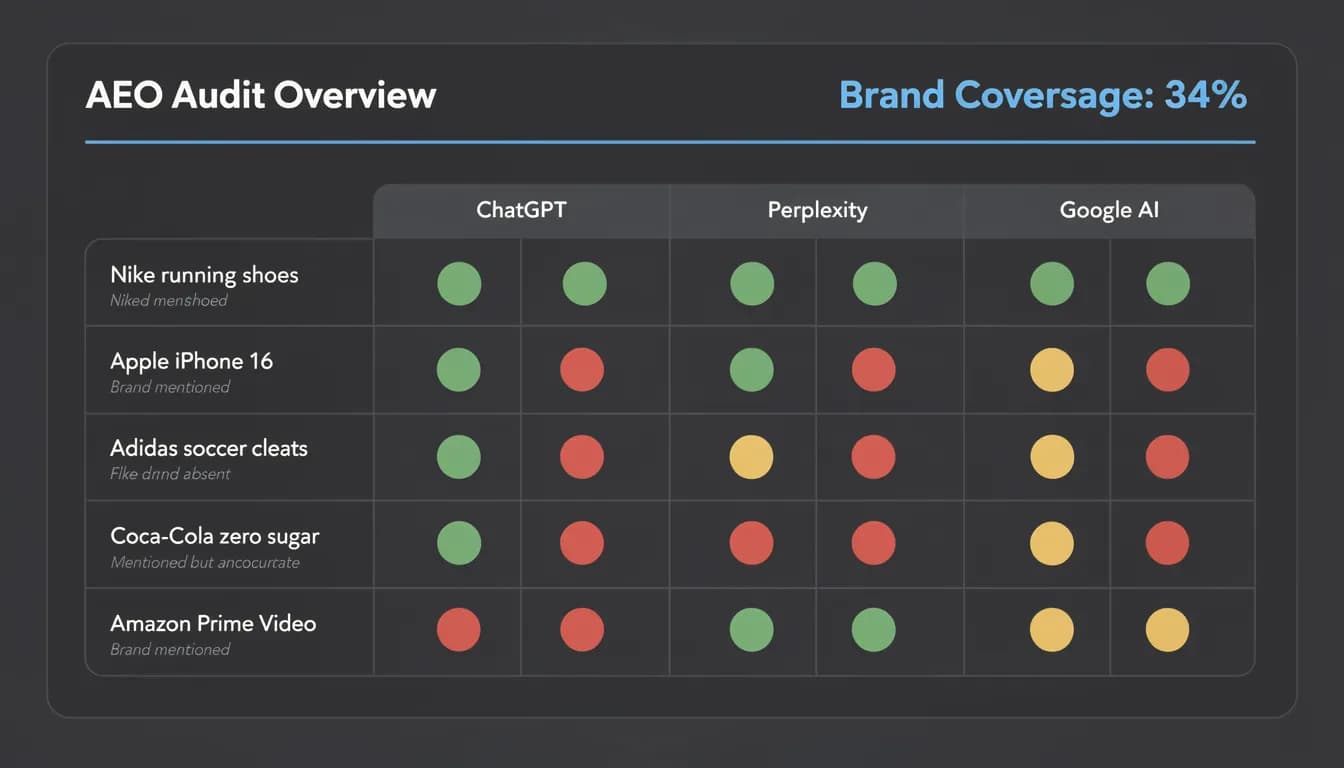
Do you know what ChatGPT says about your brand right now? Not what you want it to say — what it actually says, which prompts trigger your brand, and whether the information it has is accurate. Most marketing teams haven't done this audit. The ones who have usually find at least one thing they wish they'd found earlier. An AEO audit doesn't take a full quarter. It takes a focused afternoon, the right framework, and honest reporting back to your team about where your AI visibility stands.
What Is an AEO Audit?
An AEO audit is a systematic review of how your brand appears — or doesn't appear — in AI-generated search responses. It examines what AI engines say about your brand, your product category, and your competitors when responding to the queries your potential customers actually ask.
Unlike an SEO audit, which analyzes technical factors and ranking signals on Google, an AEO audit focuses on:
- Coverage: Which queries trigger a mention of your brand in AI responses?
- Accuracy: When AI engines mention your brand, are the claims correct?
- Sentiment: Are mentions neutral, positive, or subtly negative?
- Share of Model Voice: How often is your brand cited compared to competitors?
When to run one: Before a major product launch, at the start of each quarter, after a brand refresh or pricing change, and whenever you notice a competitor gaining market share without an obvious SEO explanation.
The 6-Step AEO Audit Process
Step 1: Define Your Target Prompt Library
The quality of your AEO audit depends entirely on the quality of the prompts you test. A weak prompt library — five branded queries and nothing else — will give you a false sense of security. Build a prompt library across four categories:
Category queries — how buyers discover your type of product:
- "best [your category] tool for [primary use case]"
- "top [category] platforms for [ICP]"
- "[category] tools compared"
Comparison queries — competitive evaluation moments:
- "[your brand] vs [Competitor A]"
- "[your brand] alternatives"
- "is [your brand] worth it"
Problem queries — pain-point searches upstream of category awareness:
- "how do I [core problem you solve]"
- "why is [pain point] so hard for marketing teams"
Branded queries — what buyers see when they're already considering you:
- "[your brand] review"
- "[your brand] pricing"
- "is [your brand] legit"
Aim for a minimum of 20 prompts per audit cycle. More prompts = more reliable SOMV calculation.
Step 2: Run the Prompts Across All 4 Major AI Engines
AI engines give different answers to the same question. Your brand may appear consistently in Perplexity but never in ChatGPT. Google AI Overviews may describe your pricing correctly while Claude has outdated information. Testing one engine only gives you one quarter of the picture.

For each prompt, test across:
AI Engine | Version to Test | Why It Matters |
|---|---|---|
ChatGPT | GPT-4o with search on | Largest user base; most influential for B2B buyers |
Perplexity | Default (Pro if possible) | Citations visible — shows exact sources |
Claude | Sonnet or Opus | Growing share with technical/enterprise buyers |
Google AI Mode | AI Mode in Google Search | Highest volume; integrates with SEO rankings |
For each prompt × engine combination, record in a spreadsheet:
- Mentioned? (Yes / No)
- Position (first, second, or further in response)
- Sentiment (Positive / Neutral / Negative)
- Accuracy (All correct / Minor errors / Major errors)
- Competitors also mentioned (list them)
Step 3: Benchmark Against Competitors
Now run the same 20+ prompts with competitor names substituted in. You're not looking for ammunition — you're measuring baseline Share of Model Voice and identifying where competitors are consistently beating you.
Calculate your SOMV:
SOMV = (Number of prompts where your brand is mentioned) ÷ (Total prompts tested) × 100
If you appeared in 11 out of 40 prompts and your main competitor appeared in 23, your SOMV is 27.5% vs their 57.5%. That's a data point your marketing team should see on a dashboard, not discover in a crisis.
Track this number across every quarterly audit. If it's falling, something changed — either your content strategy slipped, or a competitor made a deliberate push into AI visibility. Both are actionable.

Step 4: Audit Accuracy of AI Claims
This step is where most teams find their biggest surprises. AI models learn from content published across the web — and if older, inaccurate, or outdated content about your brand exists, AI engines may cite it as fact.
Check every claim AI engines make about your brand against current reality:
Features: Are the features described actually features you offer? Are features you've added since 2023 missing entirely?
Pricing: This changes most often. Many AI engines still cite 2022–2023 pricing because that's what dominated their training data. If your current pricing differs by more than 20% from what AI says, you have a correction priority.
Use cases: Are AI engines describing your product for the use cases you actually target? Or has the description drifted toward an adjacent segment you no longer prioritize?
Competitor comparisons: How does your brand come out in head-to-head comparisons generated by AI? Are the differentiators AI cites the ones you'd choose?
For every inaccuracy found: create content that explicitly corrects the record, structured in a format AI engines can extract (FAQ schema, definition paragraphs, direct-answer headings). This is the fastest path to accuracy improvement. Entity optimization covers the full correction workflow.
Step 5: Identify Coverage Gaps
Coverage gaps are the queries where your brand is absent from AI responses — but competitors are consistently present. These are your highest-priority content opportunities.
Map your gaps systematically:
- List every prompt from your library where your brand didn't appear
- Note which competitor(s) appeared instead
- Check whether you have a page targeting that query intent
- If yes → the page exists but isn't structured for AI extraction (optimization task)
- If no → the page needs to be created (content creation task)
The most valuable gaps are the problem queries and comparison queries where competitors appear but you don't. These are the AI responses shaping your prospects' vendor shortlists before they've ever visited your website.
For a full picture of what AI visibility optimization looks like at the strategy level — not just the audit level — the companion guide covers the complete five-pillar approach.
Step 6: Build Your AEO Action Plan
Your audit findings translate into a three-priority action plan:
Priority 1 — Fix inaccuracies (this week) Wrong pricing, incorrect features, outdated positioning. These are actively hurting you. Create correction content immediately.
Priority 2 — Fill coverage gaps (this quarter) The queries where competitors appear and you don't. Build one page per significant gap, structured for AI extraction: direct-answer opening, FAQ schema, clear entity description.
Priority 3 — Improve SOMV in high-value prompts (ongoing) For the queries where you appear but your SOMV is lower than competitors, run a structured content and citation-building program. This is the long game — SOMV moves over months, not weeks.
AEO Audit Checklist
Use this reference table to track completion across your audit:
Step | Task | Done? |
|---|---|---|
1 | Define 20+ prompts across 4 categories | ☐ |
1 | Include category, comparison, problem, and branded queries | ☐ |
2 | Run all prompts in ChatGPT (search on) | ☐ |
2 | Run all prompts in Perplexity | ☐ |
2 | Run all prompts in Claude | ☐ |
2 | Run all prompts in Google AI Mode | ☐ |
2 | Record: Mentioned / Position / Sentiment / Accuracy / Competitors | ☐ |
3 | Calculate your SOMV (%) | ☐ |
3 | Calculate competitor SOMV for top 3 rivals | ☐ |
4 | Check feature descriptions for accuracy | ☐ |
4 | Check pricing mentions for accuracy | ☐ |
4 | Check use case descriptions for accuracy | ☐ |
4 | List all inaccuracies found | ☐ |
5 | List all coverage gap queries | ☐ |
5 | Tag each: needs optimization vs needs new content | ☐ |
6 | Prioritize inaccuracies for correction | ☐ |
6 | Add coverage gaps to content pipeline | ☐ |
6 | Set next audit date (3 months) | ☐ |
6 | Report SOMV baseline to stakeholders | ☐ |
6 | Assign owners for all priority actions | ☐ |
How Allable Automates Your AEO Audit
Running 20+ prompts across 4 AI engines manually — recording, comparing, calculating — takes 4–6 hours for a single audit cycle. At quarterly cadence, that's a significant research investment before you've done anything with the results.
Allable runs this process automatically. You configure your brand, your competitors, and your target prompt categories once. The platform tests across 7 AI engines on your chosen schedule, calculates your SOMV automatically, flags accuracy anomalies when AI descriptions drift from your configured brand facts, and surfaces coverage gaps alongside content recommendations for filling them.
The audit that takes a focused afternoon manually becomes a weekly dashboard update. And instead of discovering a competitor's SOMV surge in your quarterly review, you see it the week it happens — early enough to respond.
For a broader look at AI visibility tools beyond Allable, the tools guide covers the full landscape with honest evaluations.
Frequently Asked Questions
- How long does an AEO audit take?
- A manual AEO audit with 20–30 prompts across 4 AI engines takes approximately 4–6 hours: 2 hours running prompts and recording results, 1–2 hours analyzing accuracy and coverage, 1 hour building the action plan. With a platform like Allable, the data collection phase is automated — you spend 1–2 hours reviewing and prioritizing findings.
- What's the difference between an SEO audit and an AEO audit?
- An SEO audit examines how your website ranks in traditional search — analyzing technical factors (crawlability, site speed, indexing), on-page signals (keyword relevance, content quality), and backlink profile. An AEO audit examines how your brand appears in AI-generated responses — completely different systems, different ranking signals, different optimization levers. You need both. They don't replace each other.
- How often should I run an AEO audit?
- Quarterly is the recommended baseline for most marketing teams. Run an additional unscheduled audit after any major product change (new pricing tier, new feature launch, brand refresh) or after a significant competitor announcement. The more frequently your market moves, the more frequently you should audit.
- Do I need a paid tool for an AEO audit?
- No — you can run a complete AEO audit manually with just a spreadsheet and browser access to ChatGPT, Perplexity, Claude, and Google AI Mode. The free approach works well for initial baseline audits. A paid tool like Allable becomes worth the investment when you need to track SOMV trends over time, monitor multiple competitors simultaneously, or run audits more frequently than quarterly.
- What should I do if AI search has wrong information about my brand?
- Act immediately — wrong information in AI responses can directly affect sales conversations and vendor comparisons. Create content that states the correct information explicitly and directly: a dedicated FAQ page, updated pricing pages with FAQ schema, a 'common misconceptions' section in your About page. Structure it for AI extraction (direct answers, FAQ schema markup). Then submit those pages to Google for indexing and share them in contexts where AI models retrieve live data (Perplexity cites pages directly — publishing in indexed sources that Perplexity uses is a fast path to correction).
Run Your AEO Audit with Allable
Stop guessing what AI engines say about your brand. Allable runs your prompt library across 7 AI engines automatically, calculates your SOMV, and flags accuracy issues — so your audit takes hours, not a full quarter.