OpenAI API Pricing Explained: What You Actually Pay Per Token (Real Marketing Cost Breakdown)
 Written by Martin J.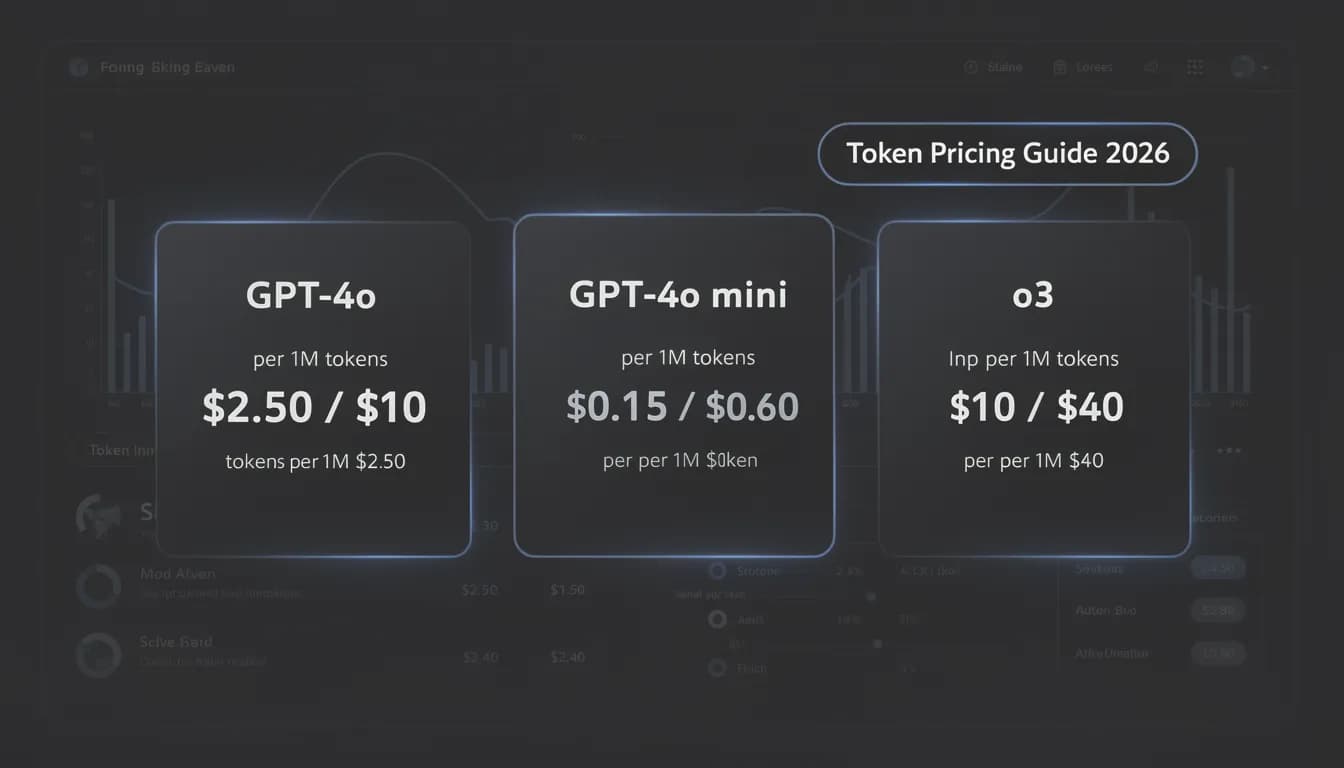
The pricing page is technically accurate. The bill at the end of the month is almost always a surprise. OpenAI's per-token model means your monthly API cost is a function of exactly how you're using it — and most teams don't find out what that function looks like until they've already committed. This is the breakdown that shows you what marketing-scale API usage actually costs, before you build anything.
Your API cost is not what you think it is. Every marketing team that integrates OpenAI starts with the same assumption — it's cheap, practically free, a few cents here and there. Then someone runs a 5,000-email personalization campaign on a Friday and opens Slack on Monday to a $400 bill. The problem isn't the pricing page. OpenAI publishes every number. The problem is the gap between "per 1M tokens" and "what your actual content workflow costs" — and almost nobody bridges it before they've already committed to an integration. Output tokens cost four times what input tokens cost. Context windows accumulate silently. The chatbot you thought would cost $30 a month is running at $1,200. None of this was hidden. None of it was obvious.
How OpenAI API Pricing Actually Works (No Jargon)
The foundational unit of OpenAI billing is the token. Not a word, not a character — a token. The practical rule: 1 token ≈ 0.75 words. A 2,000-word blog post is roughly 2,667 output tokens. A 500-word research brief you send as context is roughly 667 input tokens. Your full system prompt, your instructions, your conversation history — all input tokens, all billable.
This is where most teams miscalculate. You pay for two token streams every single time you call the API:
- Input tokens: Everything you send to the model — your prompt, system instructions, conversation context, any documents you include
- Output tokens: Everything the model generates in response — the content it writes for you
The critical number: output costs 3–4× more than input across nearly every OpenAI model. On GPT-4o, input is $2.50 per million tokens. Output is $10.00 per million tokens. A seemingly balanced prompt-to-response ratio can quietly double your expected cost.
The context window compounds this. When you run a chatbot with conversation memory, every user turn re-sends the full conversation history as input. A 10-turn conversation doesn't cost 10× one turn — by turn 10, you're sending turns 1 through 9 as input context every time. A 1,000-conversation-per-day chatbot with an average of 10 turns accumulates far more input tokens than the raw response count suggests.
Billing is usage-based, metered monthly, with no minimum commitment. You pay for exactly what you use — which sounds ideal until you realize that "exactly what you use" is harder to predict than it looks.
OpenAI API Pricing by Model (2026 Complete Table)
OpenAI operates a tiered model lineup, and the right choice for your use case makes a significant cost difference. These are verified 2026 prices:
Model | Input (per 1M tokens) | Output (per 1M tokens) | Best for |
|---|---|---|---|
GPT-4o | $2.50 | $10.00 | Long-form content, nuanced copy, complex analysis |
GPT-4o mini | $0.15 | $0.60 | High-volume tasks, email subjects, short ad copy |
GPT-4 Turbo | $10.00 | $30.00 | Legacy integrations, large-context document work |
o3 | $10.00 | $40.00 | Complex reasoning, multi-step research, strategy |
o3-mini | $1.10 | $4.40 | Structured reasoning at reasonable cost |
o4-mini | $1.10 | $4.40 | Latest efficient reasoning model |
text-embedding-3-small | $0.02 | — | Semantic search, content similarity, tagging |
text-embedding-3-large | $0.13 | — | High-precision vector search, recommendation systems |
A few observations that matter for marketing teams:
GPT-4o mini is the workhorse. At $0.15 input / $0.60 output, it's 94% cheaper than GPT-4o on output. For tasks that don't require high creative judgment — subject line testing, metadata generation, content briefs, FAQ answers — mini is almost always the right choice.
GPT-4 Turbo is a legacy trap. At $10.00 input / $30.00 output, it costs 4× GPT-4o for most tasks without a meaningful quality advantage on standard content. If you're using it, that's worth reviewing.
Reasoning models (o3, o4-mini) are specialists. o3 at $40.00 per million output tokens is built for tasks where multi-step logical chains matter — structured content audits, complex briefs, research synthesis. Not for bulk content generation.
Embeddings are effectively free for most teams. $0.02 per million tokens for text-embedding-3-small means embedding a 1,000-article content library costs roughly $0.06. Worth knowing if you're building semantic search on your own content.
Real Marketing Cost Scenarios (What You'll Actually Spend)
Numbers in isolation don't tell you much. Here's what five common marketing workflows actually cost using the 2026 pricing above.

Scenario 1: Blog Post Generation (2,000 words)
Typical token breakdown: 3,000 input tokens (system prompt + research brief + outline) + 2,700 output tokens (the article).
- GPT-4o: $0.0075 input + $0.027 output = ~$0.035 per article
- GPT-4o mini: $0.00045 input + $0.00162 output = ~$0.002 per article
For a single article, either model is negligible. But a real content operation adds research prompts, outline generation, draft revisions, and quality checks — multiply raw cost by 3–4× for a realistic workflow. At 20 articles/month with GPT-4o: roughly $2–$3/month in pure API cost. With GPT-4o mini: under $0.15/month.
Scenario 2: Ad Copy Variations (10 variants per campaign)
Typical breakdown: 300 input tokens (product brief + brand voice) + 500 output tokens (10 short variants).
- GPT-4o: ~$0.006 per campaign
- GPT-4o mini: ~$0.0004 per campaign
Running 20 campaigns per month with GPT-4o: ~$0.12/month. The model choice here almost doesn't matter — the real cost is elsewhere.
Scenario 3: Personalized Email Campaign (5,000 emails)
This is where it starts to matter. Personalizing 5,000 emails means 5,000 individual API calls, each with customer context.
Typical: 500 input tokens (customer data + template) + 300 output tokens (personalized email body).
- 5,000 emails → 2.5M input tokens + 1.5M output tokens
- GPT-4o: (2.5 × $2.50) + (1.5 × $10.00) = $6.25 + $15.00 = $21.25 per campaign
- GPT-4o mini: (2.5 × $0.15) + (1.5 × $0.60) = $0.375 + $0.90 = $1.28 per campaign
This is a meaningful number if you're running monthly campaigns at scale.
Scenario 4: 100-Article SEO Content Operation
Realistic per-article workflow (with iterations): 5,000 input tokens + 3,500 output tokens × 3 passes.
Per article: 15,000 input + 10,500 output tokens. 100 articles: 1.5M input + 1.05M output tokens.
- GPT-4o: (1.5 × $2.50) + (1.05 × $10.00) = $3.75 + $10.50 = $14.25/month
- GPT-4o mini: (1.5 × $0.15) + (1.05 × $0.60) = $0.225 + $0.63 = $0.86/month
The API cost itself is surprisingly low. Your real cost at 100 articles/month is developer infrastructure, prompt engineering time, and the hidden ops overhead that never appears on the token bill.
Scenario 5: Customer Support Chatbot (1,000 conversations/day)
This is the scenario that catches teams off-guard. Context accumulation is brutal for chatbots.
Assumption: 10 turns per conversation average. By turn 10, you're sending the full 9-turn history as input on every call.
- Per conversation: ~8,000 input tokens + 2,000 output tokens
- Daily: 8M input + 2M output tokens
- Monthly (30 days): 240M input + 60M output tokens
Model | Monthly cost |
|---|---|
GPT-4o | (240 × $2.50) + (60 × $10.00) = $600 + $600 = $1,200/month |
GPT-4o mini | (240 × $0.15) + (60 × $0.60) = $36 + $36 = $72/month |
This is the scenario worth modeling before you build. A chatbot that feels like a $30/month feature can land at $1,200/month. The model choice here is not a quality decision — it's a cost structure decision.
OpenAI API Pricing vs Claude API vs Gemini API
If you're evaluating API costs, OpenAI isn't the only option. Here's how the main competitors compare on the same task cost basis.

Provider | Model | Input (per 1M) | Output (per 1M) | Notes |
|---|---|---|---|---|
OpenAI | GPT-4o | $2.50 | $10.00 | Strong general performance |
OpenAI | GPT-4o mini | $0.15 | $0.60 | Best budget option |
Anthropic | Claude 3.5 Sonnet | $3.00 | $15.00 | Higher output quality for long-form |
Gemini 1.5 Flash | $0.075 | $0.30 | Cheapest capable model |
Applied to the 100-article scenario above (1.5M input + 1.05M output tokens):
- GPT-4o: $14.25/month
- Claude 3.5 Sonnet: (1.5 × $3.00) + (1.05 × $15.00) = $4.50 + $15.75 = $20.25/month
- Gemini 1.5 Flash: (1.5 × $0.075) + (1.05 × $0.30) = $0.113 + $0.315 = $0.43/month
Gemini 1.5 Flash wins on pure cost by a wide margin. The tradeoff is output quality consistency — for high-stakes marketing copy where tone and nuance matter, the $14 vs $0.43 difference is often worth paying.
For a full breakdown of how the Anthropic models compare, see our Claude API pricing comparison. And if you're evaluating which model to use for your marketing workflows specifically, how Claude and ChatGPT compare for marketing covers the practical differences beyond the pricing.
One underappreciated point: task routing matters more than model loyalty. A sophisticated API integration uses GPT-4o mini for classification, subject line testing, and metadata — and only escalates to GPT-4o or Claude 3.5 Sonnet when the task demands it. Teams that run everything through a single premium model are paying 5–10× what they need to.
How to Reduce Your OpenAI API Costs
Once you know your actual cost structure, there are four levers that consistently move the number.
1. Batch API: 50% Discount for Asynchronous Work
OpenAI's Batch API processes requests asynchronously (24-hour completion window) at exactly 50% of the standard price. If your use case doesn't require real-time response — bulk content generation, large-scale analysis, overnight processing — this is the most direct cost reduction available. A $14.25/month 100-article operation becomes $7.13/month with zero change to output quality.
2. Prompt Caching: Reduce Repeated Context Costs
When you send the same large context repeatedly — a brand voice guide, a product catalog, a long system prompt — OpenAI caches the input tokens after the first call. Cached input tokens are billed at a reduced rate. For integrations with consistent system prompts (like a chatbot), this can reduce effective input costs by 25–50% without any code changes.
3. Model Routing: Use the Right Tool for Each Task
The single highest-leverage cost optimization is assigning models by task complexity rather than defaulting to one model for everything.
Task type | Recommended model | Reason |
|---|---|---|
Content classification, tagging | GPT-4o mini | Simple pattern recognition |
Ad copy variants | GPT-4o mini | Speed and volume matter |
Long-form article drafts | GPT-4o | Coherence and depth |
Complex strategic analysis | o3-mini | Structured reasoning |
Semantic search/embeddings | text-embedding-3-small | Cheapest capable option |
4. Context Management: Truncation Strategies
For conversational applications, limit the context window you send with each call. Instead of sending the entire conversation history, summarize older turns and only pass the last 2–3 turns verbatim. This prevents the exponential context accumulation that drives chatbot costs into the hundreds per month.
For teams building AI-powered marketing automation, these optimizations are what separate a proof-of-concept from a scalable production system.
Frequently Asked Questions
- How much does the OpenAI API cost per month for a small team?
- It depends entirely on your usage pattern. For a small content team generating 20 blog posts per month with GPT-4o, the raw API cost is roughly $2–$3/month. For a team running a customer chatbot with 1,000 conversations per day, the same model costs over $1,200/month. The number that matters isn't which plan you're on — it's how many tokens your specific workflow generates. Model the token math before you build.
- Is GPT-4o mini good enough for marketing content?
- For high-volume, lower-stakes tasks — ad copy variants, subject line testing, content categorization, metadata generation — yes, GPT-4o mini is more than adequate and costs 94% less than GPT-4o. For long-form articles, brand-critical copy, or content where subtle tone matters, the quality gap with GPT-4o is noticeable. Most production systems use both: mini for volume, GPT-4o for content that directly represents the brand.
- How does OpenAI API pricing compare to Claude pricing?
- At comparable quality tiers, Claude 3.5 Sonnet runs $3.00/$15.00 per million tokens (input/output) versus GPT-4o at $2.50/$10.00. Claude costs roughly 20% more on input and 50% more on output. For the same 100-article workflow, that's $20.25/month on Claude versus $14.25/month on GPT-4o. Whether that premium is worth it depends on your quality requirements — many teams find Claude's output more consistent on long-form content. See the full Claude API pricing comparison for a detailed breakdown.
- Can I use OpenAI API for free?
- There's no permanent free tier for the OpenAI API in 2026. New accounts receive a small credit for initial testing, but production usage requires a paid account with a credit card on file. You're only charged for what you use, and there's no monthly minimum — so low-volume usage can cost very little. The closest to free is Gemini 1.5 Flash, which offers a free tier with rate limits.
- What's the cheapest way to use ChatGPT for business?
- Three-part answer. First, use GPT-4o mini for anything that doesn't require premium output quality — it's 94% cheaper. Second, enable the Batch API for non-real-time workloads (50% discount automatically). Third, evaluate whether a purpose-built platform subscription is actually cheaper than building and maintaining your own API integration. For most non-technical marketing teams, the total cost of ownership on a custom integration is higher than it appears on the token pricing page.
The Alternative: All-in-One AI Marketing Platforms
All-in-one AI marketing platforms like Allable run multi-model AI across their content, SEO, and campaign tools on a flat subscription — no per-token billing, no surprise month-end invoices, no infrastructure to maintain. The break-even is straightforward: if your team would spend more than 20 hours building and maintaining a custom API integration, a subscription at €31/month costs less than the developer time before you factor in a single month of API charges.