Human-in-the-Loop AI Marketing: The Decision Framework Your Team Actually Needs
 Written by Martin J.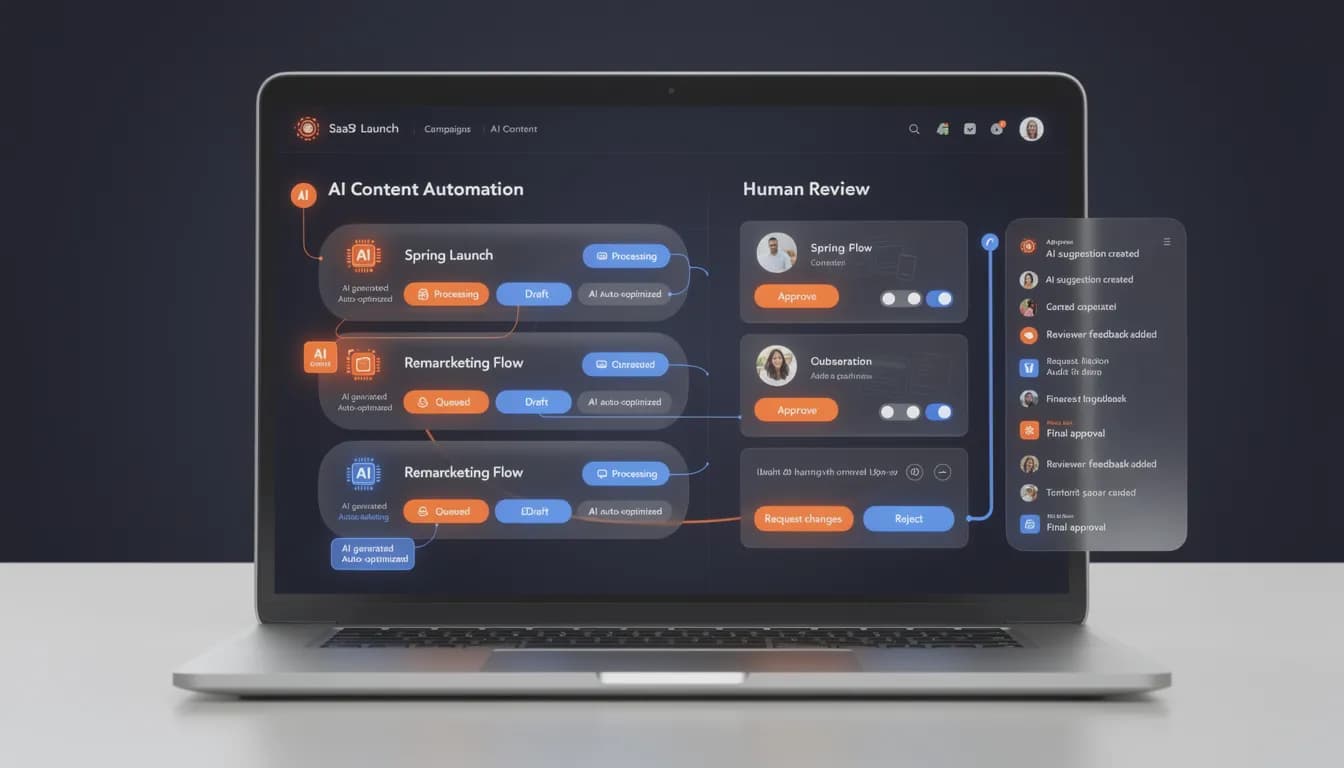
Your AI marketing stack is probably running more autonomously than you realize — and not by design. You never decided which calls AI should make alone. That's not an AI problem. That's a governance problem — and it's why teams with identical tools get wildly different results.
You've probably heard "human in the loop" used as a reassurance phrase — a way of saying "don't worry, a human checks everything." But the teams actually scaling AI marketing without losing brand control or burning budget aren't checking everything. They're being surgical about which decisions require human judgment, when that judgment needs to happen, and what happens when it doesn't. That's a framework, not a feeling. And most marketing teams don't have one.
This guide builds that framework from the decision level up — not from the tool level. What you'll get is a 4-tier decision matrix you can apply across your entire marketing function, a cross-team governance model, and a 3-phase implementation sequence. Whether you're managing a lean team running four AI tools or an enterprise stack with dozens of automations, the underlying logic is the same.
What Human-in-the-Loop Actually Means in Marketing AI
The textbook definition of HITL comes from machine learning: a feedback loop where humans review model outputs and correct them to improve the model over time. That definition is accurate, but it's not what matters most to a marketing team running AI-assisted campaigns, content, and SEO in 2025.
For your marketing operation, human-in-the-loop means something more operational: the deliberate placement of human decision points inside AI-driven workflows to control quality, brand alignment, and strategic risk. (If you're newer to agentic AI in marketing, our what is agentic marketing primer provides useful context for what follows.) It's about knowing which outputs AI can publish, send, or spend money on autonomously — and which ones must touch a human first.
The distinction matters because the failure modes are different. A purely supervised AI workflow bottlenecks on human bandwidth and defeats the purpose of automation. A purely autonomous AI workflow compounds errors at machine speed — wrong brand voice across 200 content pieces, ad creative that violates brand guidelines at $10k/day spend, CRM personalization that feels uncanny instead of helpful.
According to Digital Applied's Q1 2026 benchmark, 73% of marketing teams now have HITL as a formal standard in their AI workflows. The teams in the remaining 27% are not moving faster — they're accumulating invisible debt. Deloitte's analysis found that marketing organizations without formal HITL governance miss their AI ROI targets by 1.6x on average. That gap isn't caused by bad tools. It's caused by the absence of a decision architecture.
Your competitors who are scaling AI marketing effectively are not doing it by automating everything. They're doing it by knowing precisely where to stop automating — and building that knowledge into a repeatable system your whole team can follow.
The 4-Tier HITL Decision Matrix for Marketing Teams
The core of any HITL governance system is a tiered decision framework — a way of classifying decisions by their reversibility, brand impact, and budget exposure. Here's the framework we use at Allable.ai and recommend to our customers.
Tier 1 — Full Autonomy (AI decides and executes, no human approval needed)
These are decisions that are low-stakes, easily reversible, and don't affect brand voice or budget:
- Internal data tagging and segmentation updates
- A/B test variant generation (not selection — generation)
- Performance report compilation and scheduling
- Keyword clustering and keyword-level bid recommendations (flagged for review, not executed)
- First-pass content brief generation
HITL position: After the fact. Humans review outputs in batches, not in real time.
Risk if skipped: Minimal. Errors are isolated and correctable in the next cycle.
Tier 2 — Supervised Autonomy (AI decides, human can override within a time window)
These decisions involve moderate brand exposure or spend, but the error cost is contained:
- Ad copy variations for active campaigns (below a defined spend threshold — typically $500/day)
- Email subject line selection from AI-generated options
- Social post scheduling and caption optimization
- Product description updates for existing SKUs
- On-page SEO adjustments within defined parameters
HITL position: Inline notification with override window (typically 2-4 hours). If no action is taken, the decision executes.
Risk if skipped: Recoverable, but requires active monitoring. A poorly performing email subject line costs opens, not brand trust.
Tier 3 — Human-Approved Execution (AI recommends, human approves, AI executes)
This is where most teams underestimate HITL friction. These decisions require a real approval gate:
- Campaign launch and budget increase above threshold
- New audience targeting definition
- Landing page copy that will serve as an A/B test control variant
- Brand-new content for high-authority pages or pillar posts
- CRM personalization logic that changes how you communicate with large segments
- Creative direction for paid social (visual + copy combination)
HITL position: Hard gate. Nothing moves without explicit approval. AI generates the recommendation with evidence; human decides.
Risk if skipped: Compounding. A wrong decision at Tier 3 executes at scale and generates downstream data that informs future AI decisions.
Tier 4 — Human-Only (AI supports but does not decide or draft)
These decisions should never be AI-autonomous — not because AI can't produce an output, but because the accountability, judgment, and context required are irreducibly human:
- Brand positioning changes or messaging pivots
- Crisis communication and sensitive category responses (data breaches, PR incidents)
- Ethics reviews for targeting practices
- Vendor and tool selection for new AI capabilities
- Strategic partnership messaging
- Content addressing health, legal, financial, or politically sensitive topics (YMYL)
HITL position: AI can research, summarize, and provide evidence. Human authors the decision and the communication.
Risk if skipped: Severe and non-recoverable in some cases. Brand damage from AI-generated crisis response or ethically problematic targeting can outlast any campaign.
How to use this matrix: Run your current AI workflows through it. Assign every automated decision to a tier. If you find Tier 3 or Tier 4 decisions executing autonomously — that's your immediate fix list.
How HITL Governance Works Across Your Marketing Functions
A decision matrix is a starting point. The harder part is applying it consistently across functions that have different velocity, different risk profiles, and different definitions of good output. Here's how HITL governance plays out in the four main marketing functions.
Content Marketing
Content is where most teams start with AI, and it's where the HITL failures accumulate fastest. The volume potential is real — AI can genuinely accelerate your content production. But volume without voice control creates a different kind of problem: content that ranks but doesn't convert, because it doesn't sound like anyone.
Your HITL checkpoints for content:
- Brief level (Tier 2): AI can generate research summaries and structural briefs. A human editor reviews before the writing stage begins.
- Draft level (Tier 3): AI drafts require human review before they enter your CMS — not just for errors, but for strategic fit, brand voice, and factual accuracy.
- Publish level (Tier 4 for pillar content): Your most important content — thought leadership, product pages, comparison content — should always be human-authored or human-rewritten, not just human-reviewed.

For a deeper look at how AI tools integrate into a content workflow that maintains quality, see our guide to agentic marketing tools.
Paid Advertising
Ads is the function where HITL failure is most immediately expensive. AI can optimize bids, test creative variations, and flag anomalies faster than any human team. But the same automation that saves you hours can also spend your monthly budget in 48 hours if something misfires.
Your HITL checkpoints for paid:
- Daily budget changes above 20%: Tier 3 gate — AI recommends, human approves.
- New audience targeting: Tier 3 gate — especially for lookalike or interest-based audiences where demographic sensitivity is a risk.
- Creative concept approval: Tier 4 for brand-new creative directions — AI generates variants, human approves the concept before any spend.
- Anomaly response: Tier 2 — AI flags performance anomalies and pauses if a defined threshold is breached; human reviews within 4 hours.
SEO and Organic Growth
SEO decisions tend to feel lower-stakes because the feedback loop is slow. That's precisely why HITL governance is critical here — by the time you see the impact of a bad decision, you've been executing on it for months.
Your HITL checkpoints for SEO:
- Keyword strategy changes: Tier 3. Shifts in keyword targeting affect your content calendar, internal linking, and topical authority — all of which compound over time.
- On-page optimization recommendations: Tier 2 for existing pages, Tier 3 for pillar pages.
- Technical SEO changes: Tier 3 at minimum, Tier 4 for anything touching site architecture or crawl budget.
- AI-generated content for ranking: Tier 3. Quality review before indexing is non-negotiable.
For teams using AI to support organic growth specifically, our guide to automated marketing workflows covers the evaluation criteria worth applying to any automation you're considering.

Marketing Automation and CRM
This is the function where AI governance gets philosophically interesting — because automation is the point. Your CRM and marketing automation exist to communicate at scale. HITL here is not about slowing down the automation; it's about governing the logic that drives it.
Your HITL checkpoints for automation:
- New sequence design: Tier 3. Any new email sequence, lifecycle trigger, or behavioral automation needs human review of the logic before it goes live.
- Segment definition changes: Tier 3. AI can recommend segment refinements based on behavior; humans approve before the segment is applied to active campaigns.
- Personalization logic: Tier 4 for anything that touches sensitive data or makes assumptions about identity, health, financial situation, or personal circumstance.
- A/B test result implementation: Tier 2. AI can apply a winning variant from a completed test; human reviews the reasoning before the next test runs.
If you're running marketing automation with AI in the loop, the single highest-leverage HITL checkpoint is always the sequence logic — not the copy.
Building Your HITL System: A 3-Phase Implementation
Knowing your tiers is one thing. Installing a working HITL system in an active marketing operation is another. Here's the sequence that works.
Phase 1 — Audit and Classify (Week 1-2)
Before you add any new process, document what's already running autonomously. List every AI-assisted workflow in your stack: every tool, every automation, every report that fires without a human approving it. For each one, answer three questions:
- What decision is being made or executed?
- What's the cost of a wrong decision? (Brand? Budget? Data?)
- Is a human reviewing this before or after it executes — or not at all?
Map each workflow to a tier using the decision matrix above. You're not changing anything yet. You're creating a clear picture of where your current exposure is.
Most teams discover two things in this audit: they have more Tier 3 decisions running as Tier 1 than they expected, and they have Tier 2 decisions generating bottlenecks that manual review doesn't solve (because review isn't happening — people are just approving without reading).
Phase 2 — Install Gates (Week 3-5)
Start with your highest-exposure misclassifications from Phase 1 — Tier 3 or Tier 4 decisions that are currently running autonomously. These are your priority gates.
For each gate, define four things:
- Who approves? A named role, not someone on the team.
- What does the approval require? A review of the AI output only, or review plus additional context?
- What's the response window? If no one approves within X hours, what happens? (The AI waits, or a default applies.)
- How is it logged? Every approval or override should be traceable.
Don't try to install all your gates at once. Pick the highest-risk workflows and run them manually for two weeks before automating the gate itself. You'll catch logic errors in your approval criteria before they create new problems.
Phase 3 — Tune and Scale (Week 6+)
Once your gates are installed and running cleanly, you have data. Look at your override rate: how often are humans changing AI recommendations before approving them? A high override rate on a Tier 2 decision is a signal that the decision should move to Tier 3. A near-zero override rate on a Tier 3 decision over an extended period is a signal that you might be able to relax to Tier 2 — but verify that carefully before automating the gate away.
The goal isn't to automate everything eventually. The goal is a system that stays appropriately calibrated as your AI capabilities evolve. Some decisions will always stay at Tier 4, no matter how good the AI gets. That's not a limitation — it's a feature.
The 5 HITL Failure Patterns (and Why Smart Teams Still Fall for Them)
These are the patterns we see most often in teams that have good intentions around HITL but are still losing ground to compounding AI errors.
1. The Rubber Stamp Gate A Tier 3 gate exists on paper, but the approval is a formality. The reviewer clicks approve without reading the output because volume is too high, the interface doesn't surface context, or the culture treats AI output as inherently trustworthy. The gate provides compliance optics but zero actual control. Fix: reduce the volume of what requires approval, not the quality of each review.
2. The Wrong-Level Reviewer A Tier 3 decision requires strategic judgment (campaign direction, audience targeting logic) but it's being reviewed by a junior team member who lacks context. They approve what looks correct syntactically without being able to evaluate it strategically. Fix: match reviewer seniority to decision tier — Tier 4 decisions need senior judgment, always.
3. The Async Approval Trap Your approval flow runs through Slack or email. Messages get buried. The 4-hour override window becomes a 48-hour delay because nobody saw the notification. Meanwhile the AI waits, or worse, a default executes. Fix: HITL notifications need a dedicated channel with a clear owner, not a thread in the general marketing Slack.
4. The One-Time Setup Your HITL framework was defined once — maybe when you first deployed a new AI tool — and hasn't been reviewed since. Your AI capabilities have changed. Your team has changed. The tiers that were appropriate six months ago may be misaligned with your current risk profile. Fix: schedule a quarterly HITL audit as a standing agenda item.
5. The Volume Escalation Override Under launch pressure or seasonal peaks, teams temporarily relax HITL gates just for this campaign. Those relaxations tend to become permanent defaults. The exception becomes the rule, and six months later nobody remembers why the gate existed in the first place. Fix: make gate relaxation a documented decision with an explicit expiration date, not a quiet informal adjustment.
How Allable.ai Applies HITL in Practice
At Allable.ai, we built HITL into the platform architecture rather than treating it as an optional layer on top. Every agentic action in our AI marketing feature set is classified by default into the decision tier structure described above — and you can customize which tier applies to each function based on your team's risk tolerance and workflow.
In practice, this means:
- Content agents generate briefs and first drafts, but never publish directly to your CMS without an explicit approval action. You see the output, the reasoning, and the sources before anything touches your site.
- SEO recommendations arrive as structured proposals with evidence — keyword data, competitor analysis, difficulty scores — not as silent changes to your metadata or content.
- Campaign performance signals trigger recommendations with defined confidence levels, so you know whether the AI is flagging a confirmed trend or a preliminary signal worth monitoring.
The underlying principle is that AI should make your judgment faster and better-informed — not replace it for decisions where the cost of error is non-trivial.
For teams on the Pro plan or Business plan, HITL governance settings are available at the workspace level, so you can configure approval gates once and apply them across your entire team's AI workflow — rather than managing them per-tool or per-channel.
Allable's free plan gives you a working sense of the output quality before you commit to configuring governance at scale. But the HITL framework in this guide applies regardless of which platform you use — the architecture is tool-agnostic.
Frequently Asked Questions
- What is human in the loop in AI marketing, specifically?
- In marketing, human-in-the-loop (HITL) refers to the deliberate placement of human decision points inside AI-driven workflows. Unlike the machine learning definition (humans correcting models to improve training), marketing HITL is operational: it defines which outputs AI can act on autonomously and which must receive human review or approval before execution. It's a governance architecture, not a tech feature.
- When should you use HITL versus full AI autonomy in marketing?
- The right answer depends on three variables: reversibility (how quickly can you undo the decision?), brand impact (does this decision affect how customers perceive your brand at scale?), and budget exposure (how much spend or revenue is at risk if the AI is wrong?). High scores on any one of these factors warrant at least Tier 2 oversight. High scores on two or more warrant Tier 3 or Tier 4. Full AI autonomy (Tier 1) is appropriate only when all three variables are low.
- What are the biggest risks of AI marketing automation without human oversight?
- The biggest risks are compounding errors (AI optimizes confidently in the wrong direction, and each subsequent decision reinforces the mistake), brand voice drift (automated content gradually deviates from your tone and positioning without any single piece being obviously wrong), and budget waste (ad spend or tool costs that accrue on decisions no human has validated). Deloitte's research found that teams without formal HITL governance miss their AI ROI targets by 1.6x on average — the gap is measurable, not theoretical.
- How do I know if my current AI marketing setup needs more human oversight?
- Run the audit described in Phase 1 of this guide. Map every automated decision to the 4-tier matrix. If you find Tier 3 decisions (campaign launches, major audience targeting changes, high-authority content) executing without a human approval gate, that's your signal. A secondary indicator: if your team can't easily explain why a specific AI decision was made or who approved it, your oversight is insufficient.
- Does HITL slow down marketing AI workflows?
- Poorly designed HITL does. Well-designed HITL doesn't — because it's calibrated. If you're applying Tier 3 gates to Tier 1 decisions, you're creating bottlenecks that don't correspond to real risk. The point of the tiered matrix is to concentrate human attention where it actually changes outcomes, and get out of the AI's way everywhere else. Teams that report HITL slowing them down typically have miscalibrated tiers, not too much oversight.
Put HITL Governance Into Practice
Allable builds human-in-the-loop control into every agentic workflow by default — approval gates, confidence levels, and audit trails on every AI recommendation. Free to start.