
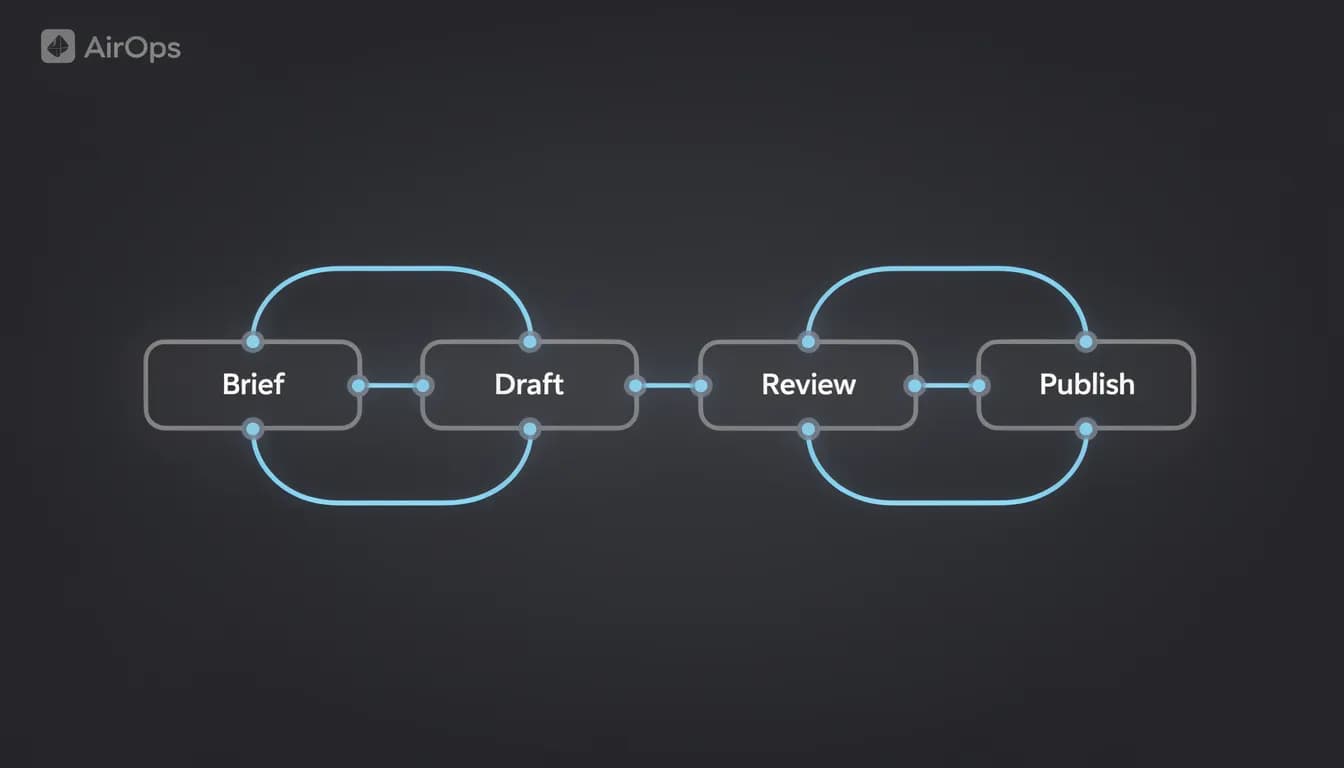
You built your content workflow around AI before anyone told you to. AirOps promises to automate that entire stack in one place — and it largely delivers. The question you're probably not asking yet: is the AirOps you can afford actually the AirOps worth having?
Something is happening in the AI content tool market that nobody's talking about loudly enough. The gap between what a Solo or Pro plan promises and what it actually delivers has quietly widened — and AirOps is one of the clearest examples of it. Your content team might be evaluating AirOps right now based on the marketing copy. But the features that make it genuinely powerful — multi-engine AI visibility tracking, brand voice at scale, API-level workflow control — are locked behind a price point that puts it out of reach for most teams that need it most. The question isn't whether AirOps works. The question is whether the version you can afford is the version worth having.
What Is AirOps?
AirOps is an AI workflow builder designed specifically for content and marketing operations teams. Think of it less as a writing tool and more as an automation layer — you define the steps, connect your data sources, feed in your brand guidelines, and AirOps executes the workflow across your content pipeline.
The core concept is called "Plays" — pre-built workflow templates that handle repeatable content tasks: writing product descriptions from a feed, generating SEO-optimized drafts from a keyword list, repurposing long-form content into social copy. If your team does the same content operations dozens of times a week, AirOps is designed to productize those processes.
It connects to Google Docs, Notion, WordPress, HubSpot, and Salesforce. On enterprise tiers, you get API access to build custom integrations. For teams already living inside those tools, the integration story is solid.
Where it diverges from standard AI writing tools is the depth of the automation. AirOps isn't trying to help you write one article better — it's trying to eliminate the manual coordination between the research, writing, QA, and publishing steps entirely.
What AirOps Gets Right
The workflow builder is genuinely powerful. If your team has well-defined, repeatable content operations, AirOps lets you turn those into automated pipelines without writing code. The Plays library gives you a starting point, and the visual builder means a content ops person — not a developer — can actually configure the logic.
Brand voice training works. On Pro and above, you can train AirOps on your existing content, style guides, and tone-of-voice documentation. The output consistency is noticeably better than prompting a generic LLM. For teams producing high-volume content that has to sound like them, this matters.
The integration depth is real. Most AI writing tools offer shallow integrations — publish to WordPress, maybe pull from a spreadsheet. AirOps goes deeper: bidirectional sync with HubSpot, structured data pulls from Notion databases, Salesforce CRM context fed directly into content generation. For an enterprise with complex data relationships, this is meaningful.
Plays (workflow templates) lower the initial setup burden. You're not starting from a blank canvas. The template library covers common content operations — SEO content generation, competitor content analysis, product description scaling — and they're customizable enough to adapt to your specific workflow rather than forcing you to adopt theirs.
Where AirOps Falls Short
The learning curve is steeper than the marketing suggests. AirOps is not a tool you open and start getting value from in an afternoon. The workflow builder requires you to think in systems — inputs, outputs, branching logic, data transformations. For teams without a dedicated content ops person who enjoys building these structures, onboarding takes weeks, not hours.
AI visibility tracking is severely limited on lower tiers. This is the most important thing I'd want you to know before signing up. If tracking whether your content appears in AI-generated answers (ChatGPT, Google AI Overview, Perplexity) is part of your use case — and in 2026, it should be — the Solo plan ($199/mo) only tracks ChatGPT. You need the Pro plan ($1,999/mo) to track three AI engines. That's a ten-times price jump for a feature that's becoming table stakes.
There's no SEO scoring or keyword optimization layer. AirOps is an execution tool, not an optimization tool. It won't tell you whether your content is likely to rank, how it compares to top SERP results, or where your keyword gaps are. You'd need a separate tool sitting next to it for that — which means more budget, more context-switching, more integration work.
The workflow flexibility is also a trap for smaller teams. The same depth that makes AirOps powerful for enterprise teams makes it overwhelming for a team of three. You'll spend more time building and debugging workflows than you save from running them — at least in the first 60 days.

AirOps Pricing: The $1,800-per-Month Cliff That Most Reviews Skip

This is the part of the AirOps story that deserves its own section.
Plan | Price | AI Engines Tracked | Key Limitations |
|---|---|---|---|
Free | $0/mo | None | No workflow runs, exploration only |
Solo | $199/mo | ChatGPT only | 1 AI engine, no brand voice training |
Pro | $1,999/mo | 3 AI engines | Full feature set |
Enterprise | Custom | Custom | API access, SLAs, dedicated support |
The jump from Solo ($199/mo) to Pro ($1,999/mo) is $1,800 per month — a 10x price increase. There is no middle tier.
For most content marketing teams, Solo isn't enough — one AI engine, no brand voice, limited workflow runs. But Pro at $1,999/mo is a significant budget commitment that requires a business case, procurement sign-off, and a clear ROI calculation. That gap is where most teams fall through.
If you're a solo marketer or a small team testing AI content automation, the Free or Solo plans are fine for exploration. But the version of AirOps that makes sense for a real content operation is the Pro plan — and at $1,999/mo, you're in enterprise software territory whether you're ready for it or not.

What AirOps AI Content Automation Actually Does
The phrase "AI content automation" gets applied to a wide spectrum of tools, so it's worth being specific about what AirOps actually automates.
Volume content generation: Feed AirOps a spreadsheet of 500 product SKUs and it generates optimized product descriptions for each one, following your brand voice and format template. This is where it genuinely earns its cost for e-commerce and large catalog teams.
Content repurposing at scale: A single long-form blog post can be automatically deconstructed into LinkedIn posts, email newsletter summaries, Twitter threads, and FAQ content — all configured once in a workflow and executed with one trigger.
Research-to-draft pipelines: You can configure AirOps to pull keyword data from external sources, run competitor analysis via integrations, and pass that structured context into a draft generation step — producing a research-informed draft without manual data assembly.
Quality checks and approvals: Workflows can include review gates — content flagged for human approval before moving to the next step. This is useful for high-stakes content (legal, compliance-heavy industries) where automation can't be fully trusted without a human in the loop.
What AirOps doesn't do is tell you whether the content it generates will perform. The automation layer is excellent; the performance prediction layer is absent. Your content can be beautifully consistent with your brand voice and still rank on page four. You'd need a separate tool to know the difference.
AirOps Alternatives: How It Compares to the Competition
If you're evaluating AirOps, you're probably also looking at tools that overlap in different parts of its feature set. Here's an honest comparison:
Feature | AirOps | Allable | Surfer SEO | Frase |
|---|---|---|---|---|
AI Visibility Tracking | Solo: ChatGPT only; Pro: 3 engines | Multi-engine (Google AI Overview, AI Mode, ChatGPT) | No | No |
Content Optimization / SEO Scoring | No | Yes | Yes | Yes |
Workflow Automation | Yes (core feature) | Partial | No | No |
Brand Voice Training | Pro+ only | Yes | No | Partial |
Starting Price | Free / $199/mo | Free / $31/mo | $89/mo | $45/mo |
Learning Curve | High | Low-Medium | Low | Low |
Best For | Enterprise content ops | SMB to mid-market AI visibility + optimization | SEO-focused writers | Brief + content generation |
AirOps vs. Surfer SEO: They don't really compete directly. Surfer is an SEO optimization tool — it helps you score and improve existing content for ranking. AirOps is a workflow automation tool — it helps you produce content at volume. If you need both, you'd need both.
AirOps vs. Frase: Frase is a research-and-brief tool that also generates content. AirOps is a workflow execution layer. Frase is significantly cheaper and easier to start with; AirOps is significantly more powerful at scale.
AirOps vs. Allable: The most direct overlap is AI visibility tracking. Allable tracks AI search presence across multiple engines (Google AI Overview, Google AI Mode, ChatGPT) starting from its free tier — the capability AirOps reserves for its $1,999/mo Pro plan. Allable also includes content optimization and competitor analysis. If AI visibility tracking plus SEO scoring is what you need, the price difference is substantial.
Who Should (and Shouldn't) Use AirOps
AirOps makes sense for you if:
- Your team produces 100+ content pieces per month and is hitting a coordination bottleneck
- You have a dedicated content ops person comfortable building workflow logic
- Your budget can absorb $1,999/mo (Pro) and you need the full feature set
- You're in e-commerce, publishing, or a content-heavy industry where volume is the constraint
- You need deep integrations with HubSpot, Salesforce, or enterprise data systems
AirOps probably isn't the right fit if:
- You're a team of 1-5 people doing standard content marketing
- Your primary goal is ranking better in Google or appearing in AI answers (you'd need additional tools)
- You want to see value in the first week — AirOps takes time to configure properly
- The Solo plan ($199/mo) is your ceiling — the Solo tier is genuinely limited for production use
- You need SEO scoring, keyword research, or SERP analysis built in
The honest summary: AirOps is a genuinely strong enterprise content automation platform with an uncomfortable pricing structure. The tier most teams can afford ($199/mo) doesn't include most of the features that make AirOps worth using. The tier that does ($1,999/mo) requires a level of organizational commitment that most content teams aren't ready to make based on a trial.
Final Verdict
AirOps is a serious platform for content automation. If you're running a content operation at enterprise scale — hundreds of pieces per month, complex data integrations, a team that needs its brand voice enforced consistently across output — the Pro plan delivers on its promise.
But most teams evaluating AirOps aren't there yet. They're looking at the tool because the workflow automation story is compelling, and then hitting the pricing page and discovering that the version they can actually use costs $1,999/mo with no viable middle ground.
The pricing structure is the product's biggest liability. A $199 Solo plan that tracks one AI engine and excludes brand voice training isn't a fair representation of what AirOps can do — and the $1,800/month jump to get there means most content teams will outgrow the Solo plan faster than they can justify upgrading.
If you're a content ops lead at a well-funded company with a real production bottleneck, AirOps Pro is worth a serious evaluation. If you're a mid-market or SMB team looking for AI content tooling that includes optimization and AI visibility tracking without the enterprise price tag, the comparison table above gives you a clearer picture of what else is out there.
Frequently Asked Questions
- Is AirOps Worth It?
- It depends almost entirely on which plan you're on. At Pro ($1,999/mo), AirOps delivers real value for content operations teams running high-volume, repeatable workflows — especially if you need brand voice consistency at scale and deep CRM integrations. At Solo ($199/mo), you're getting a limited version of the tool that may not justify the cost versus simpler alternatives. The free plan is useful for evaluation only. If you can't get to Pro, the value proposition weakens significantly.
- AirOps vs. Jasper — Which Is Better for Content Teams?
- They solve different problems. Jasper is a writing assistant — it helps individual writers produce better, faster content with AI. AirOps is a workflow automation platform — it helps content operations teams build pipelines that run without constant human input. If you're a writer looking to speed up individual output, Jasper is more appropriate. If you're building a content factory and need to automate repeatable processes, AirOps is more relevant. Most teams end up needing something from both categories.
- What Does the AirOps Free Plan Actually Include?
- The AirOps free plan is an exploration tier, not a production tool. You get access to the interface and some limited workflow runs to see how the product works, but it's not designed for ongoing content operations. You can't run meaningful volume, you don't get brand voice training, and AI visibility tracking isn't available. Treat it as an extended demo rather than a working free tier.
- Who Is AirOps Actually Built For?
- AirOps was built for content operations teams inside mid-to-large organizations — the kind of team that has defined content processes, a budget for tooling, and someone whose job is to manage the production pipeline. It's particularly well-suited to e-commerce, publishing, and enterprise marketing organizations where content volume is a primary constraint. It was not built for solo marketers, small agencies, or teams looking for a lightweight AI writing assistant.
- What Are AirOps' Biggest Limitations?
- Three stand out: First, the pricing cliff — the jump from $199/mo to $1,999/mo with no mid-tier option means most teams are either underserved by Solo or overcommitted by Pro. Second, no built-in SEO optimization — AirOps automates content production but doesn't help you optimize for ranking or AI search visibility on lower tiers. Third, the learning curve — this is a complex tool that takes weeks to configure properly, which makes it a poor choice for teams looking for immediate value.
See How Allable Compares to AirOps
Track AI search visibility across Google AI Overview, AI Mode, and ChatGPT — plus SEO scoring and competitor analysis — starting from the free tier.