AI Brand Mentions: Why 88% of Businesses Are Invisible in ChatGPT (and How to Fix It)
 Written by Martin J.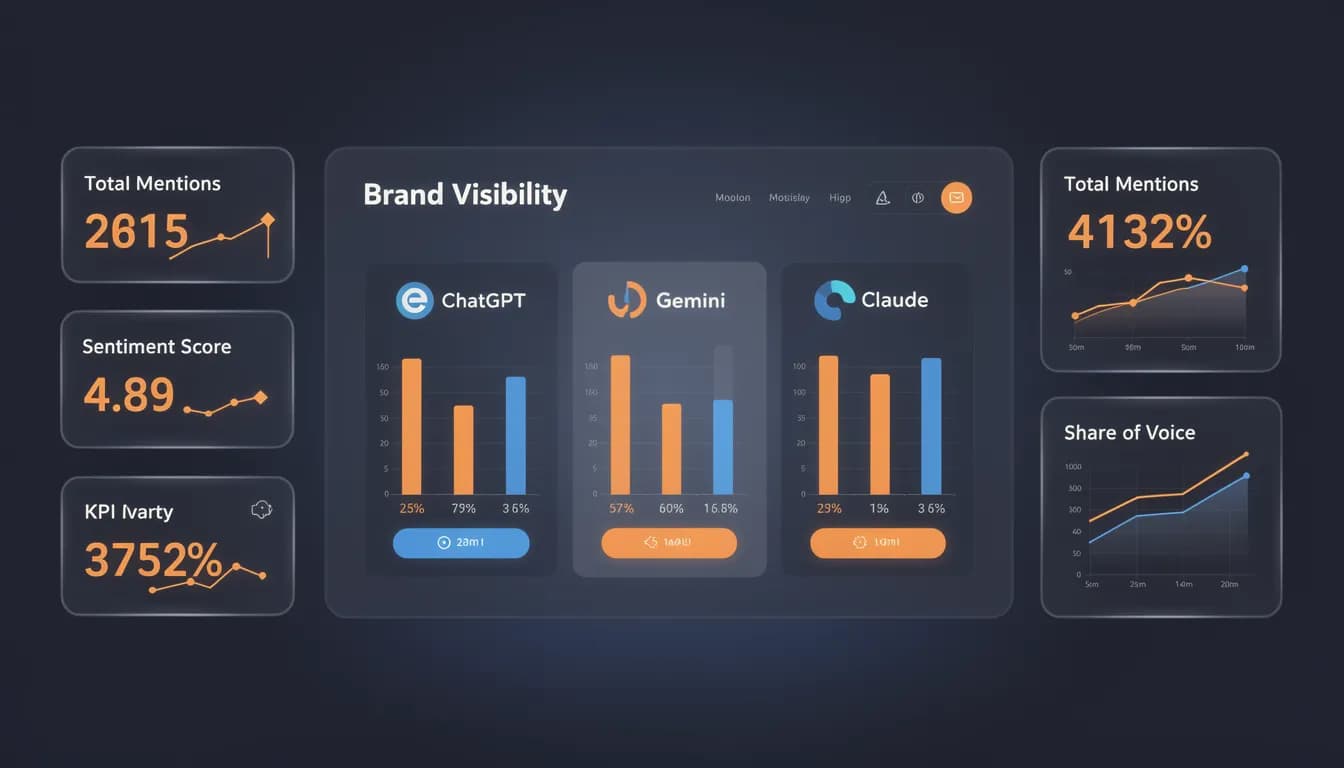
You've been optimizing for Google for years — rankings, backlinks, structured data — and you're pretty good at it. But when someone types a question about your category into ChatGPT, your brand isn't there. Not ranked lower. Not on page two. Just completely absent, as if you don't exist. And the uncomfortable part? You have no idea why. That's not a fringe scenario anymore. Adobe Analytics reported a 693% surge in referral traffic from AI platforms in 2026. You're either in the conversation, or you're watching someone else capture your audience. What's the actual gap between brands that get cited by ChatGPT, Gemini, and Claude — and brands that don't?
What Are AI Brand Mentions and Why They're Not SEO Citations
AI brand mentions are instances where a large language model — ChatGPT, Gemini, Claude, Perplexity — names your brand in a response, recommends your product, or cites your content when answering a user's question. They're not the same as backlinks or Google rankings.
When someone asks ChatGPT "what's the best tool for tracking competitor SEO?", the model generates a response based on patterns in its training data and, increasingly, real-time retrieval. It doesn't crawl the web in that moment and check your domain authority. It draws on what it already "knows" — which is shaped by what was written about your brand, how authoritatively, and how often, across the sources it was trained on.
This creates a fundamentally different visibility problem than SEO. In organic search, you can optimize your own pages and earn rankings. In AI answers, your visibility depends on what others have said about you — review sites, editorial coverage, forum discussions, third-party comparisons. Your brand website matters far less than the broader conversation about your brand.
According to research by Omni Eclipse in 2026, 88% of businesses are completely invisible in ChatGPT responses for queries in their category. They're not losing to competitors with better websites. They're losing to competitors that have been written about more, by more credible sources, in the right formats.
How to Get Mentioned in AI: The Real Mechanics
Understanding why AI models cite certain brands requires understanding where their knowledge comes from — and it's more specific than "the entire internet."
Training data composition. Large language models are trained on curated datasets that heavily weight certain content types: editorial articles, long-form guides with citations, peer-reviewed content, structured comparison pieces. A 2,000-word review on G2 or a detailed breakdown on a tech publication counts for significantly more than your own "About Us" page.
Retrieval-augmented generation (RAG). Newer model versions — particularly ChatGPT with browsing enabled and Perplexity — don't rely solely on training data. They retrieve fresh content at query time. This means recent third-party coverage of your brand directly feeds AI responses. A blog post comparing you to competitors, published last month, can already influence what ChatGPT says about you today.
Citation patterns. ChatGPT cites sources from third-party review sites approximately three times more often than it cites brand-owned content. If your brand exists only on your own website, you're structurally invisible to the citation logic these models use.
The practical implication: getting mentioned in AI is an off-page, third-party authority problem — not a technical SEO problem. You need other voices talking about your brand in the right contexts.
Three concrete actions that move the needle:
- Earn structured mentions on comparison sites. G2, Capterra, Product Hunt, Trustpilot — these appear consistently in AI training data. A detailed, keyword-rich profile on G2 with recent reviews gets cited. A thin profile doesn't.
- Generate editorial third-party coverage. Reach out to tech journalists, niche newsletter writers, and category-specific bloggers. A 1,000-word review of your product on a credible domain carries more AI citation weight than your own 5,000-word pillar page.
- Create citation-worthy content that others link to. Original research, proprietary datasets, counter-intuitive findings — these get referenced. "We analyzed 10,000 campaigns and found X" invites external writers to cite you. Generic guides don't.
ChatGPT Brand Mentions: Why Your Brand Specifically Isn't There

ChatGPT is the most-used AI assistant in the world, and its citation behavior follows a specific logic that most brands haven't adjusted to.
The model's training data skews heavily toward structured, editorial content with clear factual claims. It prefers content that sounds like it was written for a knowledgeable audience, not marketing copy. If your brand presence on the web is dominated by your own promotional content — landing pages, product descriptions, press releases — you're writing in the wrong genre for ChatGPT's citation patterns.
The review site dependency. ChatGPT draws heavily from review aggregators, comparison articles, and community discussions. When users ask "what tool should I use for X?", the model synthesizes from sources that have already made that evaluation — G2 reviews, Reddit threads, "best tools for X" roundups. If your brand appears in those sources with specific, evidence-backed mentions ("Allable.ai's AI brand tracking detected a 40% gap in our AI visibility within the first week"), you get cited. If you appear as "also a great option", you don't.
Recency matters more than you think. GPT-4o with browsing and the base model with its training cutoff both weight recent content — either through retrieval or through the simple fact that more recent data appears more frequently near the end of training runs. A wave of brand mentions generated this quarter is more valuable than a single article published three years ago.
What you can do specifically for ChatGPT visibility:
- Get reviewed on G2, Capterra, and Trustpilot with detailed, specific reviews that include use cases and results
- Pitch "best [category] tools" roundup articles to tech publications — even a mention in position 4 of a well-read article creates a citation signal
- Monitor what ChatGPT says about you today using a tool that tracks AI responses at scale, so you can identify the exact gaps before assuming what the problem is
AI Brand Visibility Across Models: ChatGPT vs Gemini vs Claude vs Perplexity
Each model has a distinct training composition and retrieval strategy. Your brand's visibility isn't uniform across them — and the fix for one model is not the same fix for another.
ChatGPT (OpenAI) As discussed above, ChatGPT weights review sites, editorial content, and structured comparisons. Its browsing capability (when enabled) retrieves fresh web content, but the base model relies on training data through its cutoff. Your priority: third-party review and editorial coverage.
Gemini (Google) Gemini draws significantly from Google's knowledge graph and from content that Google's own search index considers authoritative. This means Gemini visibility and Google SEO are more closely connected than with other models. If you rank well on Google for your category terms, Gemini is more likely to surface your brand. Your structured data — particularly Organization schema, Product schema, and FAQ schema — also influences what Gemini knows about you. Your priority: Google rankings + schema markup + Google Business Profile completeness.
Claude (Anthropic) Claude was trained on a dataset that heavily emphasizes long-form editorial content, academic-style writing, and content with explicit citations and sources. It's more likely to cite a 3,000-word in-depth analysis than a 500-word listicle. Claude also responds differently to ambiguous queries — it tends to express uncertainty and hedge recommendations, which means brands that are consistently mentioned across many sources fare better than brands with a single high-profile mention. Your priority: long-form editorial coverage with cited data, across multiple domains.
Perplexity Perplexity is the most citation-transparent of the four — it shows inline sources and retrieves content in real time. This makes it the most responsive to recent coverage: a good article published this week can appear in Perplexity results next week. It also indexes a wider range of sources, including smaller niche publications and newsletters. Your priority: recent, specific mentions in niche industry publications and active communities (Reddit, Hacker News, Substack newsletters).
The strategic implication: you need a different content and PR approach for each model — not because you're gaming the system, but because each model serves users differently and draws on different source types. A single "AI SEO" strategy that ignores these differences will optimize for one model while leaving you invisible in the others.
For a deeper look at how AI search differs from traditional SEO, our SEO vs GEO guide breaks down the full framework. And if you're newer to how LLMs index content, the LLM SEO primer covers the fundamentals. For the broader picture of how AI brand visibility is measured and benchmarked, see our AI brand visibility guide — the cluster this article is part of.
How to Track Brand Mentions in AI

You can't fix what you can't see. But measuring AI brand visibility is harder than checking your Google rankings — because AI responses aren't deterministic. The same question asked twice can produce different answers, and responses vary by model, by user context, by date, and by retrieval configuration.
Manual spot-checking (the starting point). Ask ChatGPT, Gemini, Claude, and Perplexity: "What are the best tools for [your category]?" and "Can you recommend a [your product type] tool?" Note whether your brand appears, at what position, and with what framing. This gives you a baseline — but it's not systematic.
The limitations of manual checks. You're seeing one response at one moment. AI models sample from probability distributions, which means your brand might appear in 30% of responses to a given query — and you'd never know from a single check. Systematic tracking requires running the same queries repeatedly, across models, and logging the results.
Structured AI visibility monitoring. This is where purpose-built tools matter. Allable.ai's AI brand tracking feature runs systematic query sets across ChatGPT, Gemini, Claude, and Perplexity, logs response patterns over time, and surfaces visibility gaps — showing you which queries your competitors are being cited for while you're absent. It also tracks the framing of mentions (positive, neutral, comparative) so you can see not just if you're mentioned, but how.
What to track:
- Presence rate: percentage of relevant query responses that include your brand
- Position in response: are you first, third, or buried in a list?
- Framing: are you cited as a recommended option, a comparison point, or with a qualifier ("but some users find it complex")?
- Competitor gap: who is being cited in your place, and in what contexts?
For a practical toolkit on what to monitor and how to evaluate your AI footprint, our LLM tracking tools guide covers the full metrics framework.
Frequently Asked Questions
- How does ChatGPT decide what brands to recommend?
- ChatGPT synthesizes from its training data and, when browsing is enabled, from real-time retrieved content. It weights sources that are structured as evaluations — reviews, comparisons, rankings — over brand-owned content. Brands that appear consistently in third-party review sites (G2, Capterra, Trustpilot), editorial roundups, and community discussions are significantly more likely to be cited. There's no single ranking signal — it's a probabilistic output shaped by the density and quality of mentions across its training sources.
- Does ranking on Google affect my brand's visibility in AI answers?
- It depends on the model. Gemini draws heavily from Google's search index, so strong Google rankings correlate with Gemini visibility. ChatGPT and Claude have their own training data pipelines that are less directly tied to Google rankings — though content that ranks well on Google often also appears in training data by virtue of being widely linked and read. Perplexity retrieves live search results, so Google rankings do influence it. In short: Google SEO helps, but it's not sufficient for AI brand visibility across all models.
- How to track brand mentions in AI systematically?
- Manual spot-checking is a starting point: query ChatGPT, Gemini, Claude, and Perplexity directly with category-relevant questions and note your brand's presence. For systematic tracking, you need a tool that runs standardized query sets repeatedly across models and logs the outputs — because AI responses are probabilistic, not deterministic, and a single check gives you a sample size of one. Allable.ai's AI brand tracking monitors this automatically, surfacing presence rates, position data, and competitor gaps.
- What's the difference between AI brand mentions and traditional media mentions?
- Traditional media mentions — press coverage, backlinks, brand searches — influence your SEO rankings and direct referral traffic. AI brand mentions influence what AI assistants say about you when users ask for recommendations. As AI referral traffic grows (Adobe reported 693% YoY in 2026), the gap between brands with strong AI presence and those without is widening. They're related but distinct: a press mention in a major publication can drive both SEO value and AI citation probability, while a G2 review primarily drives AI citation signals with minimal direct SEO impact.
Your Next Move Isn't More Content — It's Different Content
The 88% of businesses invisible in ChatGPT aren't losing because they publish less. Most of them publish plenty. They're losing because their content strategy was designed for a different distribution system — one where you control your own destiny through technical optimization and on-page signals. AI visibility doesn't work that way. Your brand's presence in AI responses is a function of what others say about you, in what formats, on which platforms. The brands that will own AI-generated answers in your category over the next 18 months are the ones that figure this out now.